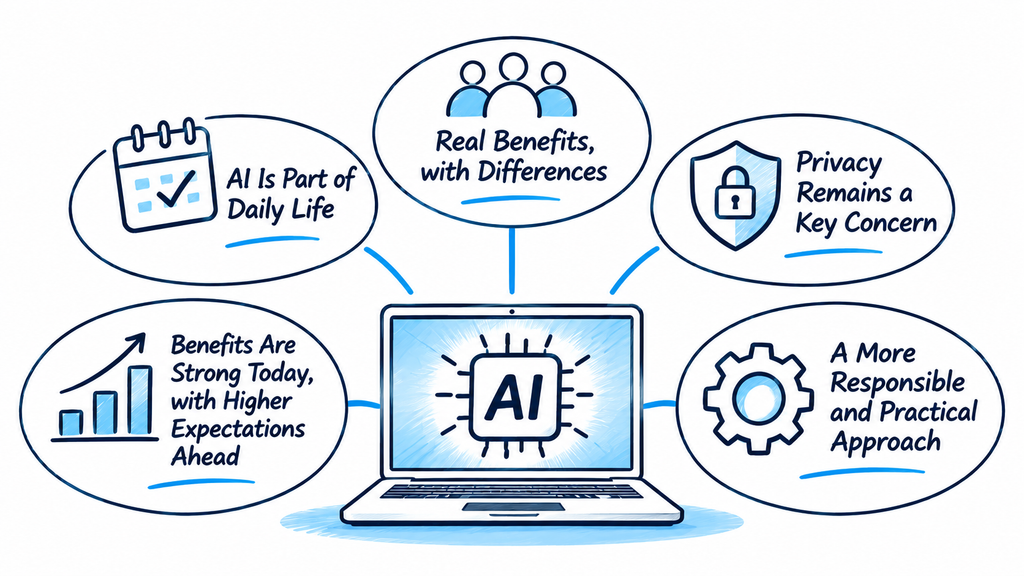
Over time, AI has become an important part of my everyday life. I use it for work, learning, research and personal tasks. What started as occasional use has gradually become part of my daily routine, and I continue to discover new ways it can help me.
This made me curious about how other people experience AI. Do they find it as useful as I do? How frequently do they use it? What concerns them, and how do they feel about its impact on their lives in the years ahead?
To explore these questions, I conducted a small survey using two sources. Through Google Forms, I collected 28 responses from my personal and professional network. I also commissioned Pollfish, a paid survey platform, to collect responses from US participants, resulting in 100 qualified responses. One of the first interesting observations came from Pollfish’s screening process. Of the 144 people screened, 44 reported never using AI and therefore did not qualify for the main survey. Nearly one in three had not used AI at all. This was an important reminder that, despite the attention AI receives, we should not assume everyone is already using it.
What Did We Ask?
I kept the survey deliberately short, focusing on six questions to understand how people use AI and how they feel about its impact on their lives.
1. How frequently do you use AI?
2. What do you use AI for?
3. How has AI affected your everyday life?
4. How do you expect AI to affect your life over the next five years?
5. What concerns you most about AI?
6. What is your age group?
These questions allowed me to explore not only how often respondents use AI, but also whether their experiences and expectations differ across age groups and between male and female respondents.
AI is Becoming Part of Daily Routines
Among the 128 qualified survey respondents, 44% reported using AI daily, while 38% used it a few times a week. The remaining 19% used AI occasionally.
Overall, 81% of qualified respondents used AI at least a few times a week, showing that AI has become a regular part of everyday life for most people who participated in the main survey.
Age and Gender Reveal Different Experiences
The survey also revealed differences in how respondents across age groups and genders use and experience AI.
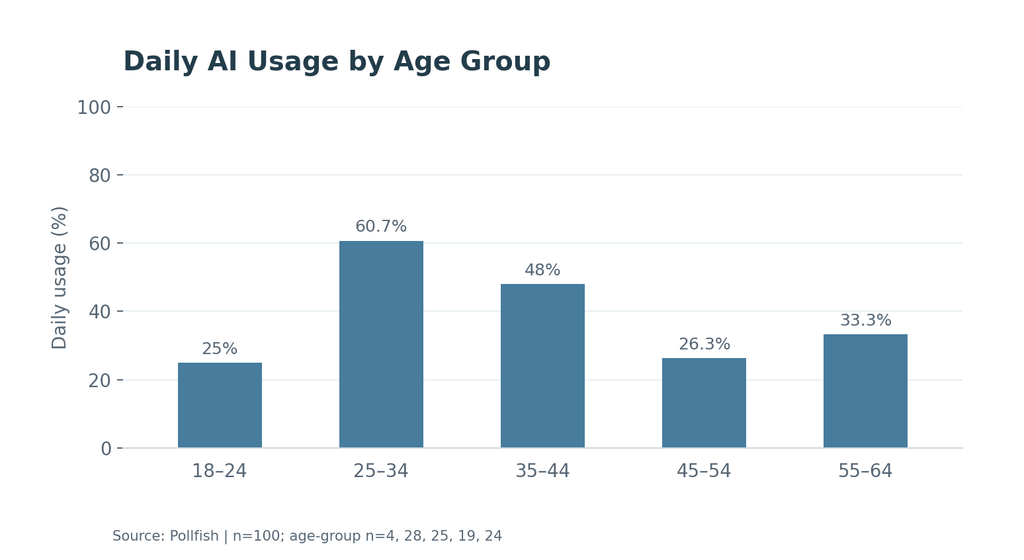
Among Pollfish respondents, daily AI usage was highest in the 25–34 age group at 61%, followed by 35–44 at 48%. Usage was lower among those aged 45–54 (26%) and 55–64 (33%). However, lower usage frequency did not necessarily mean a less positive experience. Among respondents aged 55–64, 63% reported that AI had positively affected their everyday lives.
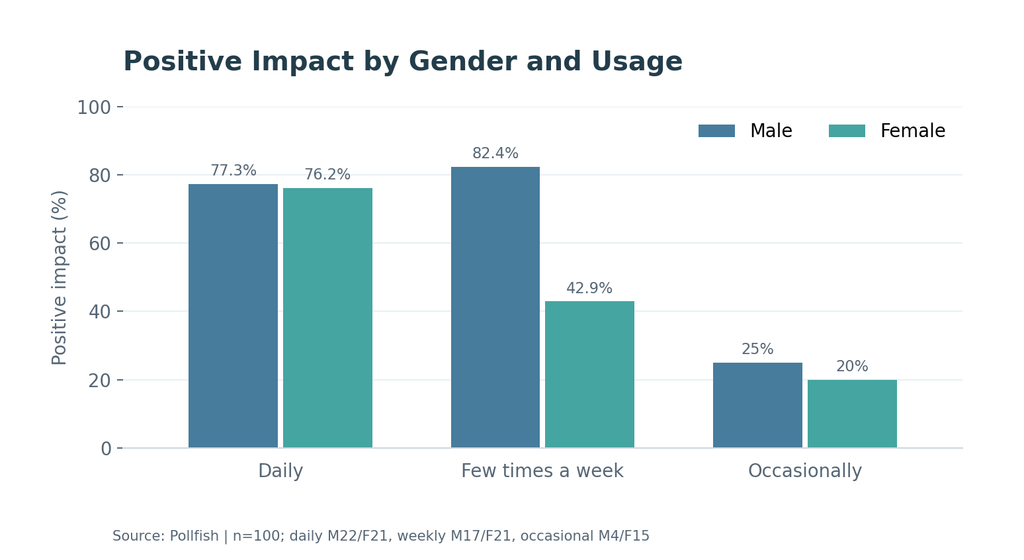
Gender differences were also noticeable. Overall, 74% of male respondents reported a positive impact from AI, compared with 49% of female respondents. However, a closer look at usage frequency revealed a more interesting pattern.
Among daily AI users, 77% of male and 76% of female respondents reported a positive impact, showing almost no difference between the two groups. The gap was much wider among those using AI a few times a week, where 82% of male respondents reported a positive impact compared with 43% of female respondents.
These findings show that demographic differences are not uniform. While the overall results suggest different experiences between male and female respondents, those differences become much smaller among daily AI users.
Privacy and Human Skills Are Leading Concerns
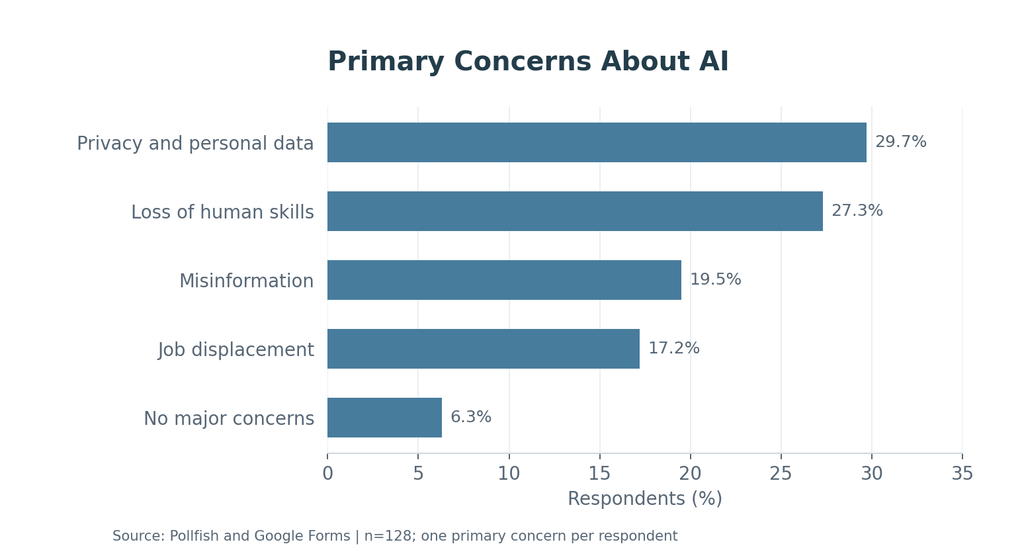
When asked to identify their biggest concern about AI, 30% of respondents selected privacy and personal data, followed by 27% who selected overdependence on AI and the potential loss of human skills.
Other concerns included misinformation (20%) and job displacement (17%), while 6% of respondents indicated that they had no major concerns about AI.
The responses also varied across age groups. Among Pollfish respondents aged 25–34, misinformation was the most frequently selected concern at 32%. For those aged 55–64, overdependence on AI and the potential loss of human skills ranked highest at 33%.
Positive Today, More Cautious About Tomorrow
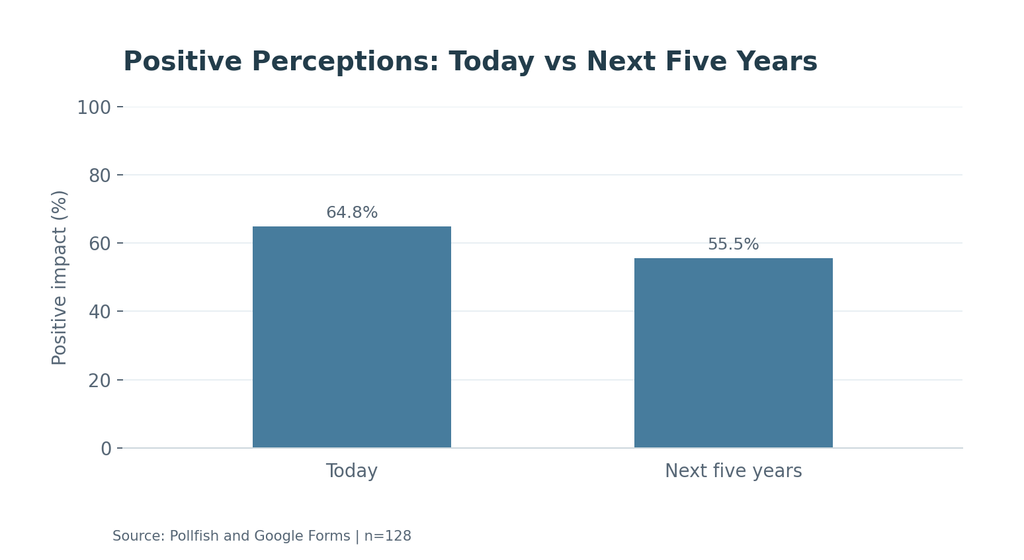
While 65% of respondents reported that AI had positively affected their everyday lives, only 55% expected a positive impact over the next five years.
The difference was also noticeable among those with positive experiences today. Of the 83 respondents who reported a positive impact, 64 also expected AI to have a positive impact over the next five years. The remaining 19 expressed neutral, uncertain or negative expectations.
Negative responses increased from just 2% when assessing AI’s current impact to 12% when considering the next five years.
Five Key Takeaways
1. AI is already part of everyday routines for many respondents.
81% of qualified respondents used AI at least a few times a week.
2. Frequent users reported greater benefits.
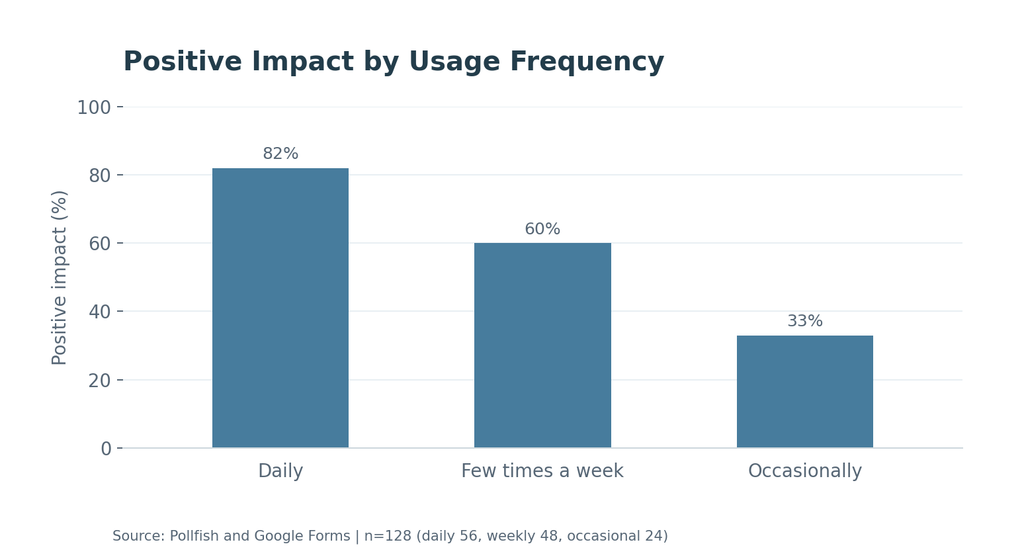
82% of daily users reported a positive impact on their lives, compared with 33% of occasional users.
3. Gender differences narrowed among daily users.
While male respondents were more positive overall, 77% of male and 76% of female daily users reported positive experiences.
4. Privacy and human skills were the leading concerns.
Privacy (30%) and overdependence on AI or the potential loss of human skills (27%) were the most frequently selected concerns.
5. Positive experiences today did not always translate into confidence about tomorrow.
65% reported a positive impact from AI today, but only 55% expected a positive impact over the next five years.
Final Thoughts
When I started this research, I wanted to understand whether other people were experiencing AI in the same way I was. The results showed that experiences differ, particularly across age groups, gender and frequency of use.
What stood out to me was the relationship between regular AI usage and perceived benefits. Respondents who used AI more frequently generally reported more positive experiences. At the same time, the screening process showed that some people had never used AI, and even those who benefit from it today are not necessarily as optimistic about its future.
For me, the most important takeaway is that AI adoption, experience and confidence are three different things. As the technology continues to evolve, understanding these differences will be just as important as understanding what AI itself can do.
Methodology Note
This research combines 128 qualified responses collected in October 2026: 100 US-based Pollfish respondents and 28 Google Forms respondents recruited through my personal and professional network.
Pollfish screened 144 participants, excluding 44 who reported never using AI. All 28 Google Forms respondents reported using AI.
Gender information was available only for Pollfish respondents. The locations of Google Forms respondents were not collected or verified.
Results are unweighted and describe the collected sample rather than the general population.