Over the years, I have worked with several onsite search technologies, from the search functionality built into ecommerce platforms to specialist providers such as Solr, Algolia and UNBXD. Technology has certainly moved forward, but one thing has remained constant: customers want to find the right products when they search.
It sounds simple. Yet anyone who has managed onsite search knows how much work goes into making that happen.
I believe search is one of those areas of ecommerce that rarely gets the attention it deserves. Businesses spend considerable time and money bringing customers to their websites, with acquisition targets, marketing budgets, campaigns and regular performance reviews. But once customers arrive and start looking for products, search does not always receive the same attention.
Part of the problem is ownership. Many retailers depend heavily on their search technology partner to drive improvements. The platform is implemented, initial problems are fixed, and gradually things settle into business as usual. There is nothing wrong with relying on a partner’s expertise, but the business must remain in the driving seat. Search needs ongoing attention, much like traffic acquisition. Someone needs to understand how customers are searching, identify where they are struggling and work with the technology partner to make improvements. Without that ownership, even a capable search platform can end up running on autopilot.
Four Measures Worth Watching
When I look at onsite search performance, I focus on four measures: search usage, click-through rate (CTR), zero-result searches and conversion rate (CR). They are not the only measures that matter, but together they provide a useful picture of the customer experience.
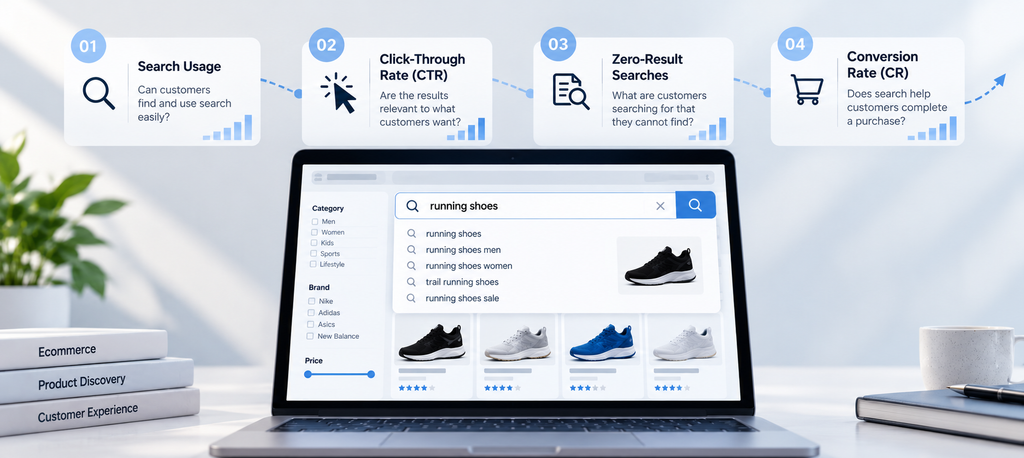
1. Search Usage: Make It Easy to Find
The first question is straightforward: how many visitors actually use search?
Usage varies between retailers. A business selling a small, specialised range of products will not necessarily see the same behaviour as a retailer with thousands of products across multiple categories. Industry benchmarks can provide a reference, but I would be careful about treating them as targets without understanding how they are calculated.
What matters is whether customers who want to search can find and use the search function easily. Sometimes the problem is surprisingly basic. A search box might blend into the background, be too small or be difficult to notice on a mobile device.
Look at how leading retailers handle this. Some use contrasting backgrounds to make search more visible. Others, such as AO.com, have used a more focused experience that draws attention to search when customers interact with it.
I would also pay particular attention to autosuggest. As customers begin typing, autosuggest can help them reach a relevant product or category without completing their query. Done well, it saves time and reduces unnecessary steps, but suggestions need the same care as the main search results. They should be relevant, easy to navigate and useful.
And do not overlook the app. Customers who have downloaded your app have already chosen to engage with your business. Many will be returning customers, with expectations that may differ from those of first-time website visitors. Search should be easy to access and use on both.
The objective is not to push every customer towards search. Some prefer browsing categories or following recommendations. The objective is to make search readily available to those who want to use it.
2. Click-Through Rate: Are Customers Finding What They Want?
Once customers search, the next question is whether the results are relevant to what they are looking for.
For me, search relevance is at the heart of a good search experience. It is not simply about returning products containing the words a customer has typed. It is about understanding what the customer wants and showing the most appropriate products in the right order.
This is where click-through rate, or CTR, becomes particularly useful. CTR tells us whether customers find something worth clicking after performing a search. When a popular query receives plenty of searches but very few clicks, I would first investigate relevance.
Are we showing the right products? Are the most relevant products appearing at the top? Does the search engine understand different ways customers describe the same product?
Of course, low CTR does not always mean poor relevance. The right products may appear but be out of stock or priced above customer expectations. Nevertheless, CTR is one of the most practical indicators of search relevance, particularly when monitored at individual query level.
I remember searching for headache tablets on a pharmacy website. The results were exactly what I expected. Then I entered the same words with a space between “head” and “ache”, and the results changed completely. To a customer, the meaning was identical. To the search engine, apparently, it was not.
Small differences in spelling, spacing and language can significantly affect what customers see. This is where technical capabilities become useful. Synonyms help search engines recognise different words with similar meanings, while stemming helps recognise related forms of a word, such as “run” and “running”. Redirects can take customers searching for specific terms directly to relevant pages. More recently, vector search has offered another way to understand customer intent rather than relying entirely on matching words, which can be useful for longer or conversational queries.
But technology alone is not the answer. I would start by reviewing high-volume queries with low CTR, looking at relevance, product availability and ranking. Repeatedly refined searches can also indicate that customers are struggling to find what they want. Significant changes to search ranking or behaviour should be A/B tested wherever practical to understand whether they improve performance.
When the Traffic Is Not Human
There is another issue I have noticed more recently. Occasionally, certain search terms show unusual spikes in volume, accompanied by very few clicks and little or no conversion. At first glance, this might look like a relevance problem, but some activity may come from automated traffic rather than genuine customers.
An unusual spike does not automatically mean bots are involved. Campaigns, trending products or changes in demand can produce similar patterns. Still, these patterns deserve investigation. Your search partner should help identify suspicious activity and, where automated traffic is confirmed, work with the appropriate technical teams to limit it. Otherwise, you risk optimising queries that do not reflect genuine customer demand.
3. Zero-Result Searches: Listen to What Customers Cannot Find
I would pay close attention to searches that return no results. These customers have told you what they want, but your website has not been able to show them anything.
Sometimes the explanation is straightforward. The product is out of stock, the retailer does not carry the brand, or the customer has made a spelling mistake. Other times, something needs fixing in the search configuration or product data. Reviewing these queries should be part of everyday search management.
One example from my time in menswear retail has stayed with me. Stone Island was among the brands customers regularly searched for, even after we had stopped stocking it. We could have simply shown a page saying there were no results.
Instead, we knew that C.P. Company was a relevant alternative for some of those customers. So we acknowledged that Stone Island was unavailable and offered a selection of C.P. Company products. The important part was being transparent. We were not pretending the alternative was what the customer had requested. We were helping them discover something else they might like.
Not every retailer will have an obvious alternative for every missing product or brand, but a search with no exact match does not always have to end with an empty page. Recurring searches for products or brands you do not sell can also provide useful information for trading and buying teams, particularly when customer demand is changing.
4. Conversion Rate: Does Search Help Customers Buy?
Ultimately, search needs to contribute to the business. Helping customers find the right product matters, but helping them complete a purchase is where the commercial value becomes visible.
Search sessions often convert at a higher rate than sessions without search. Customers who use search may already know what they want and have stronger purchase intent. But a higher conversion rate among search users does not automatically mean that encouraging more customers to search will produce the same improvement in overall conversion.
Search users are not necessarily the same kind of customers as those who prefer browsing. I would therefore compare search conversion with overall website conversion as a performance reference, rather than assume the difference represents incremental sales.
If search conversion is underperforming, I would work backwards through the journey. Are customers getting relevant results? Are products available? Are they clicking through to product pages? What happens after that?
Search cannot fix every problem in the buying journey, but it can reveal where customers are struggling. These four measures are connected: search needs to be accessible, results need to be relevant, missing results need attention, and customers need a clear path from finding a product to buying it.
Make Better Use of the Technology You Already Have
Having worked with different search platforms, I have learned that technology itself is not always the main limitation. Quite often, businesses are not making full use of the capabilities they already have.
A platform may support synonyms, redirects, ranking rules, merchandising controls and advanced relevance features. But these deliver little value if nobody is regularly reviewing performance and deciding where improvements are needed.
The retailer understands its customers, products, promotions and trading priorities. The search partner understands the technology. Both need to contribute. The business should lead with clear priorities and measurable problems, while the partner should bring ideas, challenge assumptions and help turn those priorities into improvements.
Search optimisation should be a continuous process, not a project that ends when the platform goes live.
If You Are Thinking About Changing Search Providers
There is one piece of advice I would give anyone evaluating a new search platform: understand your current performance before you start.
Document search usage, CTR, zero-result searches and conversion rate. Make sure you understand how each measure is calculated, because two platforms may report the same KPI differently. Share that information with prospective partners so they understand your current performance and can explain what they believe can be improved. Targets should be agreed openly, using existing data as a starting point. That transparency is important for both sides.
If you are considering a specialist search provider, there are several established platforms worth exploring, including Algolia, Bloomreach, Constructor and UNBXD. Each takes a slightly different approach. Algolia is known for its developer-friendly search technology, Bloomreach offers a broader commerce experience platform, Constructor focuses on AI-driven product discovery and UNBXD combines search with merchandising and product recommendations.
The right choice depends on your business needs, product catalogue, internal capabilities and existing technology. I would encourage retailers to evaluate providers against their own customer journeys and performance data rather than choosing a platform based on features alone.
Reporting requirements should also be discussed early. Make sure you can measure search performance separately by language, compare web and app, and examine individual queries, categories and time periods. I prefer having access to raw data rather than relying entirely on a fixed dashboard, as it gives the business flexibility to investigate issues that may not have been anticipated when reporting was configured.
Ease of execution matters too. A platform may offer impressive capabilities, but your team should be able to make routine changes, test improvements and measure results without unnecessary dependence on technical support. These are practical questions worth addressing before signing a contract.
A Few Final Thoughts
Search technology will continue to evolve, but retailers do not need to wait for the next breakthrough to make progress. There is often plenty of work to be done with the tools they already have.
Make search easy to use, understand what customers are searching for, investigate queries that receive few clicks or return no results, and measure what happens after customers find a product. Most importantly, make sure someone within the business owns the outcome. A search platform can return results. Making those results useful to customers, and valuable to the business, takes continuous attention.