Introduction
I think of an Order Management System (OMS) as the brain behind ecommerce fulfilment. It helps retailers decide what should happen to an order and coordinates the systems responsible for making it happen.
Retailers receive orders through websites, apps, stores and marketplaces. Stock is spread across locations, customers expect different delivery options, and each channel brings its own requirements.
The OMS brings these activities together using Business Rules defined by the retailer. It coordinates allocation and fulfilment with Warehouse Management Systems (WMS), Enterprise Resource Planning (ERP) systems and delivery platforms.
The business decides which stock can be sold online, where orders should be fulfilled, when store inventory needs protection and which delivery options to offer.
Consider a customer ordering a refrigerator that is unavailable locally but in stock at another distribution centre. Or a customer ordering a mobile phone for collection from a store where inventory must also be protected for walk-in shoppers.
Then there is a customer placing an order through Amazon, which the retailer must fulfil through its own network under the Merchant Fulfilled Network (MFN) model.
Three different orders, each with its own inventory and fulfilment decisions. Ordering should feel simple to the customer, even when the work behind it is not.
The OMS coordinates the order journey. The business defines the rules. Technology makes it happen.
What Does an OMS Actually Do?
An OMS captures orders, tracks their progress and shares information with fulfilment systems. Modern platforms go further, coordinating decisions across channels and locations through configurable Business Rules.
Managing the Order Lifecycle
A typical order may progress through Created → Confirmed → Allocated → Picking → Packed → Dispatched → Delivered. Statuses provide visibility and trigger actions. Allocation may release work to a WMS; dispatch may trigger tracking updates.
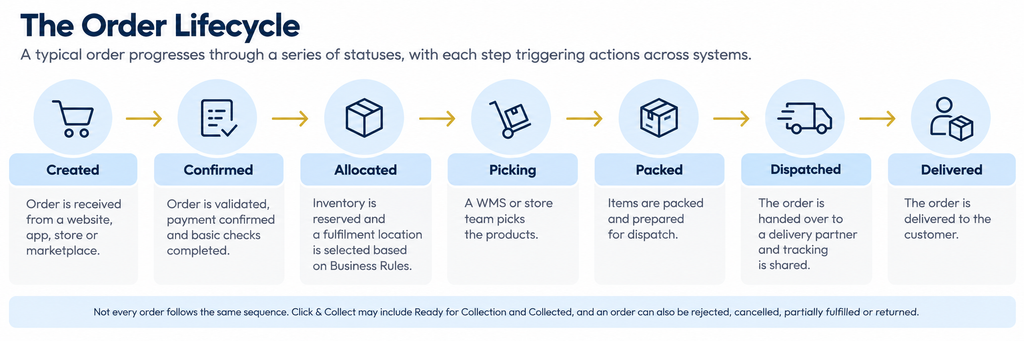
Not every order follows the same sequence. Click & Collect may include Ready for Collection and Collected, while an order can also be rejected, cancelled, partially fulfilled or returned. Names vary by platform; continuity across the journey matters more.
From Processing to Orchestration
Order capture: Receive orders from websites, apps, stores and marketplaces.
Inventory availability: Determine what stock can be promised after reservations and restrictions.
Allocation and routing: Select eligible fulfilment locations and direct work to the relevant systems.
Status management: Track the lifecycle and share updates with other platforms.
Exception management: Respond to stock shortages, rejections, cancellations and fulfilment failures.
The OMS does not physically transfer inventory, pick products or deliver orders. Warehouse teams, stores and logistics partners execute those tasks, often using their own systems. The OMS coordinates their contributions according to Business Rules.
The real value of a modern OMS is not how many orders it stores, but how effectively it helps the business decide what should happen to those orders.
Large Home Appliances and Goods: Making Inventory Work Across the Network
One challenge for retailers selling bulky products such as refrigerators, washing machines and televisions is making inventory available without unnecessarily increasing fulfilment costs. Imagine a national electronics retailer with several regional distribution centres. A customer orders a refrigerator that is unavailable locally but stocked several hundred miles away.
Automating the Fulfilment Journey
Business Rules can allow stock to be sourced from another distribution centre and transferred to the customer’s regional distribution centre. The OMS checks eligible inventory, selects the sourcing location and automatically initiates the appropriate fulfilment workflow. Once the refrigerator reaches the local distribution centre, it follows the normal delivery process.
Automation reduces manual stock searches, transfer coordination and order updates.
Making the Delivery Promise Before Checkout
Customers do not need to see the transfer process. They need a realistic delivery date before checkout. A fulfilment matrix can consider stock location, transfer lead times, postcode, delivery capacity and cut-off times. The OMS and ecommerce platform can use this information to present a delivery estimate. The integration varies, but the promise must reflect what operations can actually deliver.
Availability Is Not the Same as Profitable Fulfilment
Cross-network sourcing can recover otherwise lost sales, but moving a large appliance between regions adds cost. The business must decide when such transfers make commercial sense, considering margin, transfer cost, stock availability and customer promise. The goal is not to expose every unit everywhere; it is to make inventory available where it creates value.
Consumer Electronics and Small Appliances: Connecting Stores, Warehouses and Pre-Orders
Smaller products such as laptops, phones, tablets and coffee machines offer more fulfilment choices. The same product might be held in an ecommerce fulfilment centre and several stores, while customers choose Home Delivery, Click & Collect or Locker Collection.
One Product, Multiple Fulfilment Options
For home delivery, the OMS might allocate a laptop to an ecommerce fulfilment centre, with eligible stores as a fallback. For Click & Collect, it checks and reserves stock at the selected store and coordinates the Ready for Collection status. For locker collection, the order may be sourced from a fulfilment centre and dispatched to an eligible locker.
The reverse journey also matters: a store colleague can help a customer order an item unavailable locally from another eligible location for home delivery. The OMS can coordinate these different journeys using one order-management framework.
Why Inventory Protection Matters
A store with five phones on hand may not want to expose all five to online demand. The business may protect units for walk-in customers, account for reservations or restrict particular products from particular channels. These are Business Rules, not merely technical settings. Good inventory protection balances digital demand with store service and avoids promising stock that stores cannot fulfil.
Managing Pre-Orders
A new smartphone launch illustrates another capability: accepting orders before inventory is physically ready for dispatch. Business Rules can allow OMS to control pre-order quantities, future stock commitments and when fulfilment begins. If a customer also buys an available accessory, the retailer may choose to ship separately or consolidate delivery, balancing expectations against fulfilment cost. This is a useful variation, but the same principle applies: the business defines the process and the OMS coordinates it.
One Basket, Multiple Fulfilment Journeys
Consider a customer buying a refrigerator, a laptop and a coffee machine in a single transaction. From the customer’s perspective, this is one basket and one checkout. Behind the scenes, those products may need different fulfilment journeys.
The ecommerce platform handles the basket and checkout, presenting fulfilment options the retailer can support. The customer might choose home delivery, store collection for selected items or separate deliveries.
A customer may want the laptop immediately and the refrigerator later, or prefer one later delivery where feasible. Products delivered together may still come from different locations.
The OMS can organise a single customer order into different fulfilment groups, each with its own allocation, status and delivery promise, while retaining visibility of the overall order. Business Rules, stock, capacity and product restrictions determine what is possible.
The customer decides how they want to receive their purchase, within the options the retailer can support. The OMS orchestrates the fulfilment journey according to those choices and the Business Rules behind them.
When Things Go Wrong: Managing Exceptions
Retail operations are not always predictable. Stock records can be wrong, products can be damaged and deliveries can fail. Exceptions affect customers and cost.
When the Original Plan Fails
Imagine a laptop allocated to a nearby store. During picking, the store discovers the item is damaged. The OMS can respond in two ways. It may automatically reallocate the order to another eligible store or distribution centre if Business Rules permit. Alternatively, it may alert the inventory or operations team to investigate, correct the stock record or identify another solution.
The goal is to keep the order moving when the original plan fails.
Connecting Exceptions With Customer Communication
Operational recovery is only part of the challenge. The OMS can share exception events and order statuses with customer service, ecommerce and notification systems. If an alternative location can honour the original promise, customer contact may not be necessary. If the delivery date changes, the Business Rules may require proactive notification or approval.
Detecting a problem is not enough. The business must decide who resolves it and when to inform the customer.
Automation With Accountability
Routine exceptions can be resolved automatically; complex cases may need human judgement. The business should define which situations qualify for automation, who owns escalations and what service standards apply. The value is not merely identifying problems, but turning them into timely action and clear communication.
Measuring OMS Performance and Its Commercial Impact
Measure an OMS on the decisions and processes it controls. Its wider commercial contribution should be assessed alongside warehouse, store and delivery performance.
Five OMS Performance Measures
Order Allocation Success Rate
The percentage of eligible order lines successfully allocated to a fulfilment location. This helps reveal whether inventory visibility, sourcing eligibility and allocation rules are working as intended.
Order Orchestration Time
The time between order acceptance and successful release to the appropriate fulfilment system. Delays may point to processing bottlenecks, rule complexity or integration issues.
Automated Exception Recovery Rate
The percentage of eligible order exceptions resolved automatically without manual intervention. Define eligible exceptions carefully: some situations require a person to investigate or make a commercial judgement.
Delivery Promise Accuracy
The percentage of original delivery promises that were operationally achievable based on the information and rules available at checkout. This is different from actual on-time delivery, which also depends on warehouses, stores and carriers. Not every OMS calculates the customer promise itself.
Order Processing and Integration Success Rate
The percentage of orders successfully captured, validated and communicated to downstream systems. Failures here can prevent otherwise valid orders from progressing.
Wider Commercial Outcomes
An effective OMS may also influence incremental sales through expanded inventory availability, avoidable cancellations and fulfilment cost per order. These are important business measures, but the OMS does not control them alone. Inventory accuracy, operations, carrier performance and commercial decisions also matter.
Expanded availability does not automatically make every alternatively sourced order incremental. Likewise, a lower cancellation rate or faster delivery cannot be attributed to the OMS without examining what else changed.
Research Context
A 2025 paper by Hanuman Reddy Gali includes a figure comparing traditional retail systems and advanced OMS implementations. It illustrates potential benefits, but does not establish that an OMS alone causes a particular improvement.
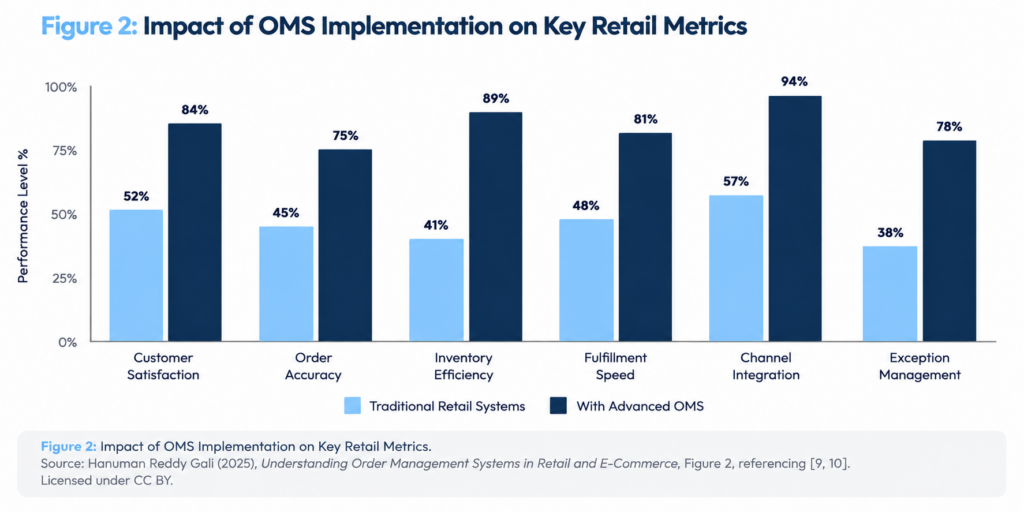
Measure the OMS on the decisions and processes it controls. Measure its business value through the commercial outcomes it helps deliver.
Final Thoughts: Technology Enables, Business Rules Decide
It is easy to look at an OMS as another technology investment. But its real value becomes visible in everyday decisions: whether to offer stock from another location, how to protect store availability, and what to do when an order cannot follow its original plan.
The system can execute those decisions consistently and at scale. It cannot decide what is commercially sensible for the retailer. That requires people who understand customers, margins, stores and fulfilment operations.
Technology teams and implementation partners turn those decisions into working processes. Business leaders must remain accountable for the rules, review the outcomes and change what is not working. A capable OMS makes fulfilment possible. Good Business Rules make it work for the customer and the business.