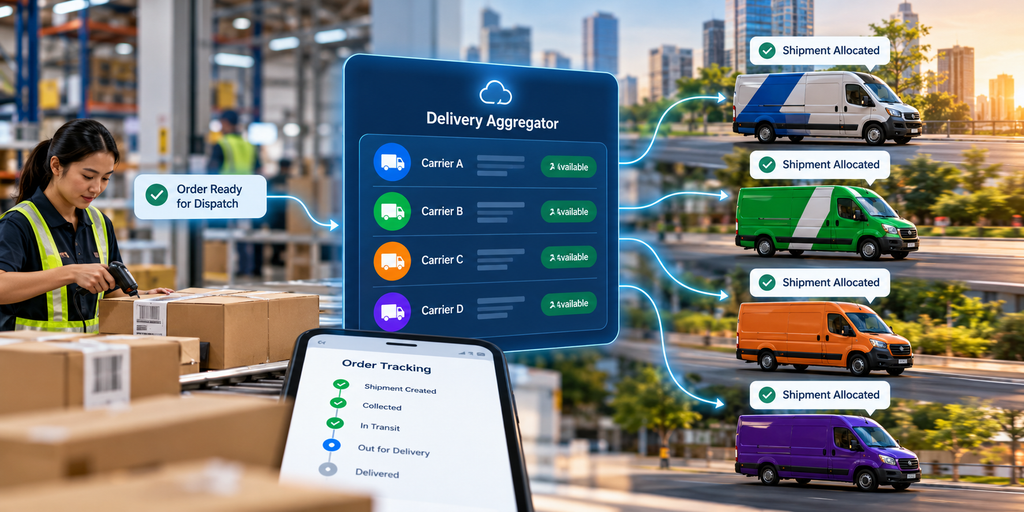
When a customer places an order online, several systems work together behind the scenes. The Order Management System (OMS) determines where the order should be fulfilled, while the Warehouse Management System (WMS) manages picking and packing. But once the order is ready for dispatch, another question needs answering: who will deliver it?
For a retailer operating across multiple cities or regions, the answer is not always straightforward. Delivery partners differ in geographical coverage, speed, capacity and cost. A partner that performs well in one city may not be the best option elsewhere.
This is where delivery aggregators come in. They connect retailers with multiple delivery partners through a single technology integration, helping select carriers, create shipments and receive tracking updates.
What Is a Delivery Aggregator?
A delivery aggregator is a technology platform that connects retailers with multiple delivery companies through a single integration.
Imagine a retailer working with five delivery partners. Without an aggregator, it may need five separate integrations to exchange shipment information, request deliveries and receive tracking updates. Each carrier may have different technical requirements, making these connections expensive and time-consuming to maintain. With an aggregator, the retailer connects to one platform that manages those integrations. Adding another carrier becomes simpler if the aggregator already supports it.
A delivery aggregator should not be confused with a delivery company. The delivery company physically transports products, while the aggregator provides technology connecting retailers with those companies.
Delivery Aggregator vs Delivery Management System (DMS)
Their capabilities can overlap, but they serve different purposes. An aggregator primarily connects delivery partners, allocates shipments and exchanges delivery information. A Delivery Management System (DMS) typically provides broader operational tools, including route planning, driver allocation, vehicle tracking and delivery execution.
Some platforms combine both capabilities. For retailers, the objective is not simply fewer integrations, but greater flexibility in choosing carriers while maintaining visibility and control.
How an Order Moves Through a Delivery Aggregator
Consider a customer ordering a mobile phone online for home delivery. After entering their address, selecting a delivery option and completing the purchase, several systems work together to fulfil the order.
1. The OMS determines the fulfilment location
The OMS identifies where the order should be fulfilled based on stock availability, customer location and business rules. This could be a regional distribution centre or a nearby store. It also holds the delivery address, selected service and promised delivery date.
2. The aggregator receives the shipment request
Depending on the system architecture, the OMS or another integrated system sends a shipment request containing the collection location, delivery address, package details and service requirements. Some retailers allocate carriers when orders are confirmed; others wait until picking and packing are completed.
3. The aggregator selects a delivery partner
The aggregator evaluates eligible carriers against the retailer’s configured rules. For next-day delivery, it identifies partners covering the destination and supporting that service. Selection may also consider capacity, cost and historical performance before submitting the shipment for acceptance.
4. The shipment is prepared for collection
Once the carrier accepts the shipment, an Air Waybill (AWB) is typically generated. In ecommerce logistics, AWB commonly refers to the shipment document or reference identifying a package within a courier’s network, even when no air transport is involved. The associated shipping label contains information such as the delivery address, shipment reference and barcode.
The AWB number is often used for tracking and differs from the customer order number. One order may generate multiple AWBs when products are dispatched separately.
Meanwhile, the WMS manages warehouse picking and packing, or the store performs equivalent activities. The shipping label is attached to the package before carrier collection.
5. Tracking information returns to the retailer
As delivery progresses, the carrier sends status updates through the aggregator to the retailer’s systems. These may include collection, transit, out for delivery and delivery confirmation. The retailer uses this information to update order statuses and communicate with customers.
What if the Carrier Rejects the Shipment?
A carrier may reject a shipment because of capacity limitations, geographical restrictions or service availability. Depending on configured rules, the aggregator may attempt allocation to another eligible carrier or return an exception for the retailer to resolve.
Choosing the Right Delivery Partner
Connecting multiple carriers is useful, but the real value comes from selecting the most suitable partner for each shipment.
Rather than always choosing the cheapest provider, retailers establish allocation rules based on commercial and operational priorities.
What Determines Carrier Selection?
- Geographical Coverage: Not every carrier serves every location. Some specialise in major cities, while others offer wider coverage.
- Delivery Promise: Same-day or next-day orders require carriers capable of meeting the selected service, including collection cut-off times.
- Delivery Cost: Rates vary by destination, package weight, dimensions and service. Retailers may prioritise the lowest-cost eligible carrier.
- Carrier Capacity: Daily shipment limits or collection restrictions can influence allocation where capacity information is available.
- Product Characteristics: A mobile phone and a refrigerator require different handling capabilities.
- Historical Performance: Delivery reliability, delays and failed attempts can inform allocation decisions where supported.
A Practical Example
Consider a retailer offering delivery through three carriers.
| Carrier | Coverage | Delivery Cost | Service |
| Carrier A | Nationwide | 25 | Next-day |
| Carrier B | Major cities | 20 | Next-day |
| Carrier C | Nationwide | 15 | Two-day |
For a customer in a major city selecting next-day delivery, Carrier B may be preferred because it meets the promise at a lower cost. Carrier C is cheaper but cannot meet the required delivery time, while Carrier A provides an alternative if Carrier B is unavailable.
Outside major cities, Carrier A may be the only eligible next-day option.
The figures are illustrative, but the principle is important: the cheapest carrier is not necessarily the right carrier.
Who Defines the Allocation Rules?
Carrier allocation rules are typically led by the Home Delivery or Logistics team, which manages delivery partners, service levels and operating costs. Ecommerce and Finance may be consulted where decisions affect customer promises, profitability or the wider P&L.
For example, the retailer may prioritise the lowest-cost eligible next-day carrier, with automatic fallback when that carrier cannot accept a shipment. Rules should be reviewed as pricing, coverage, capacity and performance change.
The retailer defines the rules; the aggregator applies them.
Managing Multiple Delivery Partners
Working with multiple carriers provides flexibility but requires operational coordination. Partners may have different collection schedules, capacities, geographical coverage and service standards. The Home Delivery team must ensure they collectively support the retailer’s commitments.
Hybrid Delivery Models
Some retailers combine their own delivery fleet with outsourced partners. For example, in-house teams may handle large home appliances, scheduled deliveries or locations with sufficient capacity, while third-party carriers handle smaller products, remote locations or additional demand.
Depending on the technology setup, an aggregator may allocate shipments across both in-house and external delivery services. Alternatively, a DMS may manage the retailer’s fleet while the aggregator handles third-party carriers.
Managing Capacity During Peak Periods
During major sales events, order volumes can increase significantly. A carrier normally collecting 500 shipments daily may not accommodate 800 shipments awaiting dispatch.
If additional capacity has been agreed with another carrier, the aggregator can distribute shipments according to configured rules and available capacity information. However, an aggregator cannot create physical delivery capacity. The Home Delivery team must plan collection schedules, capacity commitments and contingencies with carriers in advance.
Managing Service Disruptions
Vehicle shortages, missed collections or technical failures can interrupt delivery operations. If a carrier cannot collect from a distribution centre, the retailer may suspend new allocations and redirect shipments to another eligible partner.
The aggregator may support automatic or manual changes. Shipments already assigned to the affected carrier might require cancellation, reassignment and a new AWB, depending on their status and system capabilities.
Ongoing Carrier Management
The Home Delivery team remains responsible for carrier performance, commercial agreements and operational issues. Aggregator data can help identify problems and inform allocation-rule changes.
Tracking, Exceptions and Customer Communication
Once a shipment has been collected, retailers need visibility into its progress. Customers expect updates, while Home Delivery and Customer Service teams need information to manage enquiries and problems. An aggregator consolidates tracking information from multiple carriers, reducing reliance on separate carrier systems.
Tracking Shipment Progress
Carriers may use different terminology for the same event. One might report Collected, another Picked Up. The aggregator can standardise these into common statuses understood by the retailer’s systems.
Typical milestones include shipment creation, collection, transit, out for delivery, delivered and failed delivery attempts. Updates are generally linked to the AWB or tracking reference.
Tracking quality still depends on the carrier. An aggregator can consolidate reported events but cannot provide information the carrier has not supplied.
Managing Delivery Exceptions
Common exceptions include missed collections, delays, incorrect addresses, failed delivery attempts and damaged or lost shipments.
For example, if a carrier reports an unsuccessful delivery because the customer was unavailable, the aggregator passes the update to the retailer. Depending on platform capabilities, it may also generate an alert or display the issue on an operational dashboard.
Identifying an exception is not the same as resolving it. The aggregator surfaces the problem, while the retailer and carrier remain responsible for taking action.
Keeping Customers Informed
Customers should not need to understand the systems exchanging information behind the scenes. Retailers can use tracking updates to communicate through their website, app, SMS or other channels.
An Out for Delivery status may trigger a notification, while an unsuccessful attempt may generate a message explaining the next steps. Carriers may also communicate directly with customers, depending on the operating model.
The priority is consistent, reliable information that avoids conflicting updates between the retailer and carrier.
How Delivery Aggregators Connect With Other Retail Systems
A delivery aggregator exchanges information with several retail systems. The exact architecture varies, but the responsibilities are generally distinct.
Order Management System (OMS)
The OMS manages the order lifecycle and determines its fulfilment location. It may send shipment requests to the aggregator and receive carrier details, AWB references and tracking updates.
Warehouse Management System (WMS)
The WMS manages picking, packing and dispatch preparation. It may receive shipping labels and shipment references and confirm when packages are ready for collection or handed over to carriers.
Ecommerce Website and App
Customers interact with the retailer’s digital channels rather than the aggregator. Tracking information can flow through the OMS or other connected systems to support order tracking and notifications.
Delivery Management System (DMS)
For retailers with an in-house fleet, a DMS may manage drivers, routes and delivery execution. In hybrid operations, it may work alongside the aggregator, although some platforms combine both capabilities.
Each system has a different responsibility: the OMS manages the order, the WMS manages warehouse activities, and the aggregator manages connectivity and shipment information across delivery partners. Reliable integration reduces manual intervention and improves visibility.
Measuring Delivery Aggregator Performance
An aggregator should be evaluated on how effectively it allocates shipments, processes requests and exchanges information, rather than physical delivery outcomes primarily controlled by carriers.
| KPI | What It Measures |
| Automatic Allocation Rate | Percentage of shipments allocated without manual intervention. |
| Carrier Allocation Failure Rate | Percentage of requests that cannot be allocated to an eligible carrier. |
| Shipment Creation Success Rate | Percentage of requests successfully processed to create an AWB or shipment reference. |
| Tracking Update Success Rate | Percentage of carrier updates successfully processed and passed to connected systems. |
| Platform Availability | Percentage of time aggregator services are available to process requests. |
These KPIs help identify integration failures, allocation problems and unnecessary manual work. They should complement, not replace, carrier delivery performance measures.
Final Thoughts
As ecommerce businesses grow, managing deliveries across multiple locations and partners becomes increasingly complex. Delivery aggregators simplify this process by connecting carriers, applying allocation rules and consolidating shipment information.
However, technology alone cannot guarantee efficient delivery operations. Retailers still need clear business rules, sufficient carrier capacity and effective operational management.
Ultimately, the value of an aggregator is not simply how many carriers it connects, but how effectively it helps retailers allocate shipments, reduce manual intervention and maintain reliable information across their delivery network.