
Inventory Management and Supply Chain Management work closely together to ensure retailers have the right products available when and where customers need them. Commercial and inventory teams forecast demand, plan stock quantities and identify where products are likely to sell, based on customer behaviour, seasonality and promotional activity. Supply chain teams then ensure those products are received, stored and distributed efficiently across the retail network. Both functions are essential to maintaining product availability while controlling operational costs.
A customer in the West region visits a retailer’s website to buy a refrigerator. The product is available, and the retailer promises delivery within two days. However, the refrigerator is sitting in a distribution centre in the East region, far from the customer’s location.
The retailer may still be able to fulfil the order. Its Order Management System (OMS) can identify available inventory and coordinate fulfilment from the appropriate location. But moving a large appliance across the country for an individual customer order adds cost, time and operational complexity.
Now imagine the same refrigerator was already available in the West region’s distribution centre. The customer could receive the product sooner, and the retailer could avoid an unnecessary transfer.
This example highlights the importance of inventory planning and supply chain management working together. Commercial and inventory teams forecast customer demand, determine the quantities required and identify where those products are likely to sell. Supply chain teams then ensure inventory is received, stored and distributed efficiently across the retail network, based on those requirements.
Achieving sales targets requires several functions working together. Marketing generates demand, pricing influences purchasing decisions, inventory planning supports product availability, and supply chain management ensures products are positioned to serve customers efficiently. Each plays an important role in meeting customer expectations while managing costs.
Inventory planning determines what stock is needed and where. Supply chain management makes sure it gets there efficiently.
2. Demand Forecasting and Inventory Planning
Every retailer needs to answer three questions: What will customers buy? How many will they buy? And where will they buy them? Commercial and inventory teams use past sales, promotions, product launches, current stock and supplier lead times to build a forecast.
The objective is to maintain product availability without tying up unnecessary capital in excess stock.
Seasonal and Regional Demand
Demand is not the same everywhere. Consider electric heaters. If the North has colder winters than the Central region, customers in the North may buy more heaters even when the two regions have similar populations. Sending equal quantities to both could leave the North short of stock and Central with unsold products.
Inventory planners use regional sales history, seasonal patterns and expected weather to adjust quantities. Timing matters too: heaters arriving after winter peaks may be difficult to sell. Supply chain teams work backwards from the expected demand period to plan when stock must reach each location.
Planning Inventory for a Promotion
Imagine our retailer is planning a refrigerator promotion next month. The commercial team expects to sell 1,000 units across three regions. Before ordering more, the inventory team compares expected sales with stock already available.
| Region | Expected sales | Available stock | Difference |
| East | 300 | 400 | +100 |
| West | 450 | 200 | −250 |
| South | 250 | 150 | −100 |
| Total | 1,000 | 750 | −250 |
The retailer needs another 250 refrigerators overall, but the regional picture matters more. East has 100 more than forecast, while West and South face shortages. Another 250 units are due from the supplier before the promotion.
One option is to transfer 100 units from East to West, then allocate 150 incoming units to West and 100 to South. That would cover the forecast in each region. But the team should first check whether the supplier can deliver directly to the locations that need stock, avoiding an unnecessary transfer.
Delivery dates, transport costs and safety stock also matter. A forecast is an estimate, not a guarantee; additional stock may be needed when demand is uncertain or replenishment takes time. Teams review sales during the promotion and adjust the plan if demand changes.
3. Getting Inventory to the Right Location
Once the quantities are agreed, supply chain teams arrange how products will reach the right distribution centres. Some suppliers deliver directly to regional facilities. Others deliver to a central warehouse, particularly for imported or consolidated shipments. The choice depends on supplier arrangements, shipment size, timing and cost.
From Supplier to Distribution Centre
Suppose 500 refrigerators arrive at a central facility. Warehouse teams check the delivery against purchase and shipping records, identify damage or shortages and record what was received. Supply chain teams then arrange planned shipments to East, West and South based on the inventory allocation plan.
Large appliances are often moved together in palletised or consolidated truckloads, with handling methods suited to their packaging. At the destination, teams check quantities and condition, record receipt and place stock into storage. Once the necessary checks and system updates are complete, the units can be made available for fulfilment.
When Inventory Needs to Move Again
Demand can change after stock has been distributed. Once an inter-DC transfer is approved, the source warehouse picks and checks the required products, consolidates them for transport and dispatches the shipment. The receiving warehouse checks for shortages or damage and updates inventory records.
Combining several large appliances into a planned load is generally more economical than moving one unit at a time. But larger transfers are not automatically better: sending too much stock creates storage costs and the risk of further excess inventory.
The OMS uses available stock, delivery capacity and business rules to coordinate customer orders. The WMS supports warehouse activities. Neither replaces the supply chain work that positioned the stock before the order was placed.
4. How Products Are Stored in Distribution Centres
A distribution centre holding refrigerators, laptops and accessories cannot store everything in the same way. Storage choices affect capacity, safety and the time needed to retrieve products.
Different Products Need Different Storage
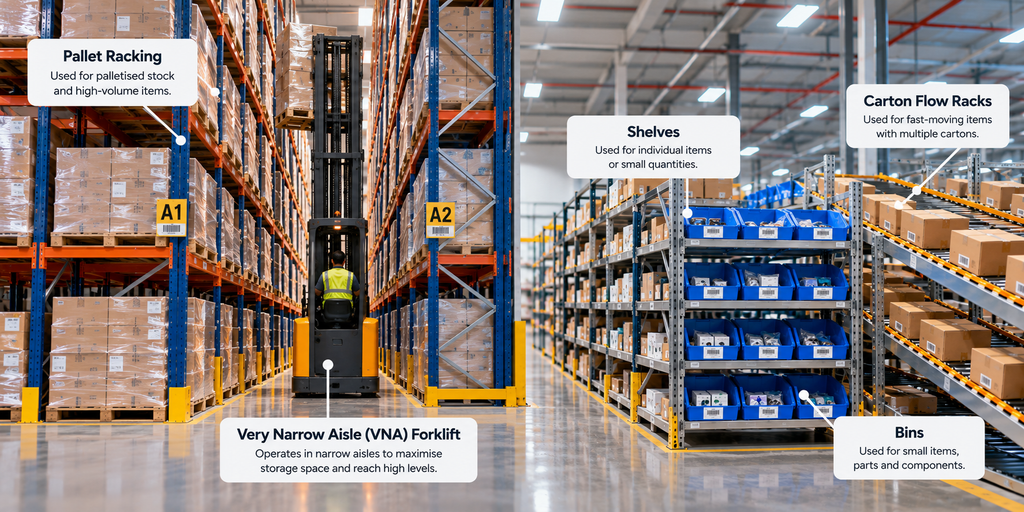
Laptops, phones and accessories may be stored on shelves, in bins or in carton-flow racks. Refrigerators and washing machines need more space and may use floor locations or suitable pallet racking, with forklifts or other equipment for safe handling.
Layout also reflects how quickly products sell. Fast-moving refrigerators should be accessible during a promotion, while popular laptops may be kept closer to picking areas. Slower-moving stock can occupy less accessible locations. Filling every available space is not useful if it makes products difficult or unsafe to retrieve.
Making Better Use of Space
Some distribution centres use taller racking and Very Narrow Aisle (VNA) forklifts to increase storage capacity. In a wire-guided system, a wire embedded in the floor carries a signal followed by sensors on the truck, helping guide it precisely along narrow aisles. Other sites use rail guidance.
Narrower aisles create more room for storage, but specialist trucks, racking and warehouse design require investment. The right approach depends on the products, stock volumes and whether the added capacity justifies the cost.
5. Store Replenishment and Inventory Availability
Distribution centres also keep physical stores supplied. Inventory planners review sales, store stock, delivery frequency and available space to decide replenishment quantities. Supply chain teams arrange the deliveries.
Small Products: Regular Replenishment
A busy store may sell laptops and accessories faster than a smaller location. Rather than send every store the same quantity, planners allocate stock based on demand. At the distribution centre, warehouse teams pick and scan products, then combine them into cartons, totes or roll cages for each store.
Transport teams plan routes that may serve several stores on one trip. On arrival, store teams check and scan the delivery, then move products to the shop floor or backroom. Regular replenishment supports availability without forcing every store to hold large amounts of stock.
Large Appliances: Display and Delivery
Large appliances often work differently. A store may display several refrigerator models so customers can compare them, while most saleable units remain at a regional distribution centre for home delivery. Some retailers do keep limited saleable stock in stores, depending on space and their operating model.
Supply chain teams must still deliver new display units for product launches and arrange removal of older models. Discontinued or damaged displays may be transferred for clearance, inspection or outlet sale. Store replenishment therefore includes both products customers take home immediately and products they examine before arranging delivery.
6. Managing Excess Inventory and Reverse Logistics
Products do not always sell as expected. Older models, returns and display stock can tie up cash and occupy valuable space. Commercial and inventory teams decide whether to discount, transfer, refurbish or return these products. Supply chain teams manage the movements.
Clearing Fragmented Stock Through Online Channels
Imagine a retailer with a large number of physical stores, each holding a few laptops from an older model. Each store has only a small quantity, but together they may represent hundreds of unsold units. Local demand may not be enough to clear them quickly.
A central view of store inventory allows the retailer to offer those laptops online as clearance stock, reaching customers beyond the individual stores. Depending on its capabilities, the retailer can fulfil orders from stores or bring remaining units together at a distribution centre. The second option involves physical transfers; the first may not. Both can help recover cash and free store space.
Outlets and Reverse Logistics
Outlets offer another route for open-box, refurbished, returned, discontinued or former display products. Items need inspection and clear grading before sale. A refrigerator with cosmetic damage may work perfectly but should not be described as new. Serial-number records can help track individual products and their condition.
Reverse logistics covers stock moving back through the network: excess goods returning from stores, display units being collected, or returned products going to inspection, refurbishment or an outlet. Combining collections with planned delivery routes can avoid unnecessary trips. Items that cannot be reused or repaired may need responsible recycling or disposal.
Return to Vendor
Some products can be returned to suppliers under agreed terms. This is known as Return to Vendor (RTV). Commercial or purchasing teams confirm which items qualify and obtain any required supplier approval. Inventory and supply chain teams identify, consolidate and dispatch the products.
The supplier may issue a credit, provide replacement stock or settle the return another way, depending on the agreement. Finance teams ensure the records reflect the outcome. RTV is not available for every product, so the supplier agreement matters as much as the physical movement.
7. Measuring Inventory and Supply Chain Performance
Strong sales alone do not prove that inventory is well managed. A retailer could sell well while holding too much stock, or reduce inventory only to lose sales through shortages. A small set of measures helps teams see both sides.
Stock availability: Are products available for customers to buy in the locations where demand exists?
Forecast accuracy: How closely did predicted demand match actual customer demand? Stockouts can hide demand that never became a sale.
Inventory turnover: How often is stock sold and replaced? The right level differs by category.
Ageing inventory: Which products have remained unsold long enough to need action?
Supply chain cost: What does it cost to transport, store and handle stock, including transfers between locations?
These measures should be reviewed together. Faster turnover is not a success if popular products are unavailable. A transfer may protect sales but still be too expensive to justify. Commercial, inventory and supply chain teams need a shared view of availability, sales, stock investment and operating costs.
Final Thoughts
Inventory management and supply chain management are closely connected. One helps retailers anticipate demand and decide what stock is needed; the other helps position, store and move it efficiently. The work continues after products reach stores or warehouses, through replenishment, transfers, clearance and returns.
ERP, OMS and WMS support these activities, but technology cannot fully compensate for poor planning or stock in the wrong place. The aim is not to hold more inventory or move it more often. It is to make products available when and where customers need them, without carrying unnecessary costs.