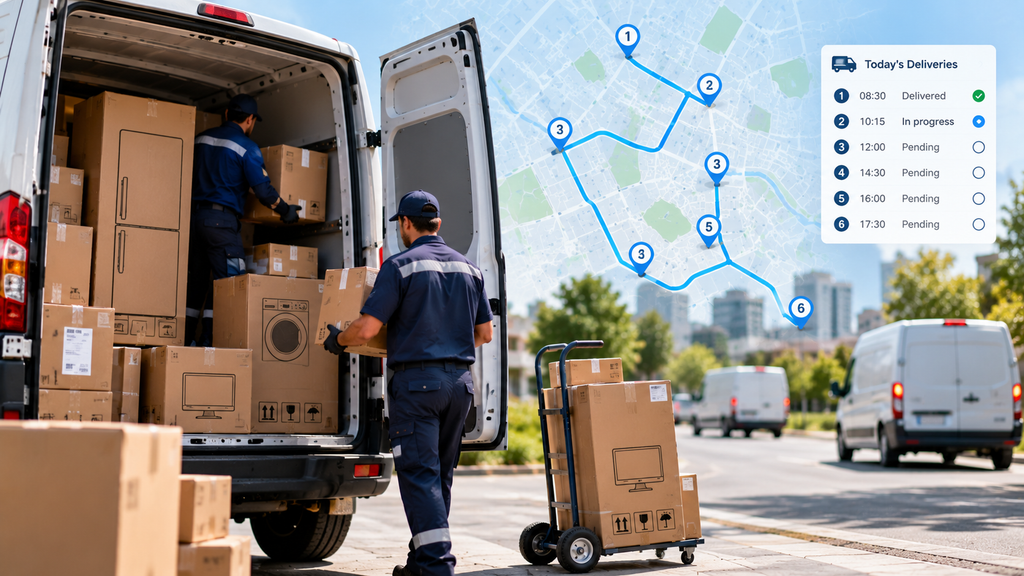
When a customer places an online order, several systems work together to fulfil it. The Order Management System (OMS) determines where the order should be fulfilled, the Warehouse Management System (WMS) manages picking and packing, and a delivery aggregator may help allocate the shipment to a delivery partner. But the journey does not end when the order leaves the warehouse.
The final stage, getting the product into the customer’s hands, is known as last-mile delivery. Delivering a mobile phone is very different from delivering a refrigerator: one may travel with dozens of parcels, while the other may require a two-person team, a scheduled slot and installation. This is also where operational decisions become visible to customers. A missed slot or damaged product can undermine an otherwise smooth shopping experience.
What Is Last-Mile Delivery?
Last-mile delivery is the movement of an order from a distribution centre, fulfilment location or local delivery hub to the customer’s address. Despite its name, the distance may be a few kilometres or considerably longer. The work includes scheduling, route and vehicle allocation, loading, customer communication and confirmation of delivery.
Small Parcels and Large Home Appliances
Small parcels, such as phones, accessories and clothing, are commonly delivered by couriers making many stops along a route. Productivity depends heavily on delivery density and travel time between stops.
Large home appliances and goods, such as refrigerators, washing machines and televisions, need more vehicle space, careful handling and sometimes two-person crews. Customers may choose a delivery slot and purchase installation or removal services. These differences shape delivery capacity, cost and service standards.
How Last-Mile Delivery Works
The process varies by retailer, product and delivery model, but usually follows five stages.
1. Planning and Scheduling
The Home Delivery team or delivery partner confirms which shipments are ready, the promised delivery windows and the resources available. For large appliances, vehicle capacity, delivery locations, handling time and installation requirements all affect the daily plan.
2. Route and Driver Allocation
Shipments are grouped into routes according to location, customer time windows, traffic conditions and realistic working hours. A Delivery Management System (DMS) may help assign routes to drivers or delivery teams. The goal is to meet customer commitments, not merely minimise distance.
3. Vehicle Loading and Dispatch
Once routes are finalised, shipments are loaded in the planned delivery sequence, accounting for dimensions, weight and safe handling. Drivers check their delivery manifest and assigned shipments before departure.
4. Delivery Execution
Drivers follow their routes, hand over products and complete any agreed additional services. Driver applications may provide directions and allow status updates. If delivery cannot be completed, the driver records the reason so the next action can be arranged.
5. Proof of Delivery
Proof of Delivery (POD) confirms that the shipment reached the customer. Electronic POD (ePOD) may include a signature, photograph or timestamp. For appliances, the record may also confirm installation or product condition. The information feeds back into the retailer’s order status.
Different Last-Mile Delivery Models
Retailers choose delivery models based on product requirements, order volume, geographical coverage and cost. Many use more than one approach.
In-House Fleet
The retailer operates its own vehicles and teams, gaining greater control over scheduling, handling and service standards. This can suit large appliances and installation services, but brings fixed costs for vehicles, drivers, maintenance and supporting operations.
Outsourced Delivery Partners
Third-party couriers or specialist logistics providers manage day-to-day delivery execution. This can expand geographical coverage and provide flexibility, particularly for small parcels. The retailer still owns the delivery promise made to the customer, even when another company performs the delivery.
Hybrid Model
A retailer may use its own appliance fleet in major cities and outsource deliveries in lower-volume areas or during peak periods. The aim is to match delivery resources to demand and service requirements.
Express and Quick Commerce
Orders fulfilled from nearby stores or local hubs may be delivered by motorcycles, bicycles or smaller vehicles. Unlike scheduled appliance routes, quick-commerce orders arrive continuously, requiring dynamic rider allocation and close attention to travel time and local coverage.
Delivery Planning, Vehicle Loading and Route Optimisation
Small operational decisions can have a significant effect on delivery costs and productivity. Three areas deserve particular attention: delivery slot capacity, loading sequence and geographical density.
Delivery Slot Capacity
Offering a slot requires more than checking whether a vehicle is free. A two-person team might complete eight appliance deliveries in a day, but that does not mean four can automatically be booked in the morning and four in the afternoon. Addresses, traffic, product handling and installation time determine practical capacity. When the DMS is integrated with ecommerce, available slots can be shown at checkout.
Reverse-Sequence Vehicle Loading
Imagine a lorry carrying refrigerators and washing machines for deliveries throughout the day. Morning deliveries should generally be placed near the rear doors, with evening deliveries further inside, closer to the cab. This reverse-sequence loading follows the Last In, First Out (LIFO) principle: products needed first are loaded last.
Correct sequencing reduces the need to move heavy appliances repeatedly, saving time and lowering the risk of damage. Load planning must still respect safe weight distribution, securing requirements and product dimensions.
Delivery Density and Route Efficiency
Delivery density, or drop density, describes how closely stops are concentrated. Forty deliveries in a compact neighbourhood may be more efficient than twenty spread across distant locations. Route clustering groups nearby addresses into practical routes, reducing travel time between stops.
In quick commerce, the road layout matters as much as straight-line distance. On roads where U-turns or crossings are difficult, assigning riders to particular sides of the road may reduce wasted travel. Efficient planning balances customer windows, vehicle capacity, road restrictions and operating cost rather than simply choosing the shortest route.
When Deliveries Go Wrong
Even well-planned deliveries can be disrupted by traffic, breakdowns, incorrect addresses, restricted access or customer unavailability. A failed attempt means another journey may be needed, increasing cost and consuming capacity. For large appliances, rebooking may also require a two-person crew and a suitable time slot.
A delay at one stop can affect the rest of a route. An installation that takes longer than expected, for example, may put later appointments at risk. Home Delivery teams need visibility into progress so they can contact affected customers, adjust the route where practical or arrange another slot. Rebooking must account for available capacity rather than simply moving the shipment to the following day.
Accurate addresses, delivery reminders and contact details help reduce unsuccessful attempts. Historical delivery patterns may also help suggest convenient time windows, where suitable data is available, while leaving the final choice with the customer.
The Customer Experience
For customers, delivery is often the final impression of an online purchase. Clear and accurate communication is essential, especially when a specific date or time slot has been promised.
Retailers should share meaningful status updates, expected arrival times and changes to the original promise. Where available, live tracking and updated Estimated Times of Arrival (ETAs) can help customers plan their day, particularly when someone needs to be home to receive an appliance.
When problems occur, proactive communication is better than leaving customers uncertain. More notifications do not necessarily mean better service: the priority is accurate, timely and relevant information that customers can trust.
Measuring Last-Mile Delivery Performance
Performance should be assessed against three objectives: meeting customer promises, using resources efficiently and controlling cost. Five practical KPIs are:
| KPI | What It Measures |
| On-Time Delivery (OTD) | Share of deliveries completed within the promised date or time window. |
| First-Attempt Delivery Success | Share of shipments delivered successfully on the first attempt. |
| Cost per Delivery / Drop | Average operating cost per completed delivery. |
| Drops per Driver per Day | Average completed deliveries per driver during a working day. |
| Vehicle Utilisation | Use of available weight, volume or delivery capacity, as appropriate. |
These measures should be reviewed by delivery model. A small-parcel courier can complete far more stops than a two-person appliance team providing installation. The aim is not simply to maximise drops or minimise cost, but to balance productivity with dependable service.
Final Thoughts
Last-mile delivery brings together planning, vehicle capacity, route efficiency, drivers and customer commitments. Better delivery density can reduce cost, correct loading can improve productivity, and accurate communication can improve the customer experience. Success is not simply delivering faster or completing more stops. It is delivering reliably, managing costs and keeping the promises made to customers.