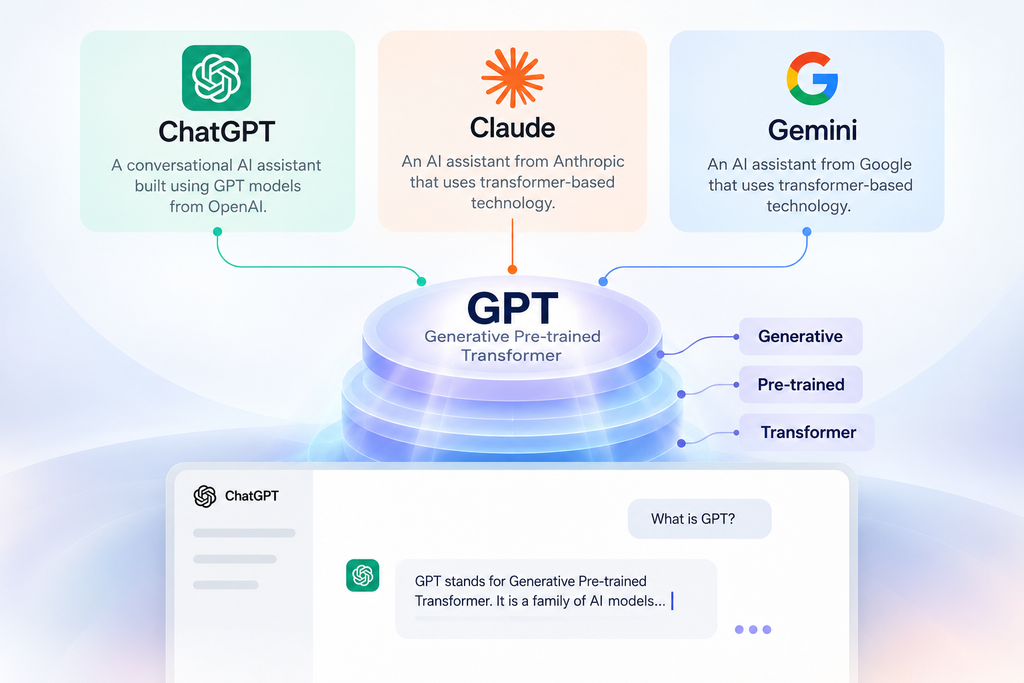
Most of us have heard of ChatGPT, and many use it to write emails, find information, develop ideas or simply ask questions. But have you ever wondered what GPT actually stands for? And do other AI tools, such as Claude and Gemini, use similar technology?
GPT stands for Generative Pre-trained Transformer. It is the name of a family of AI models developed by OpenAI. Other AI models, including Claude and Gemini, also use transformer-based technology. They are not called GPT, but they share some of the same underlying principles.
Fun Fact: Have You Ever Watched ChatGPT Write?
Have you noticed how ChatGPT’s answers appear gradually on your screen, almost as if someone is typing? That is not simply a typing animation. GPT generates its response piece by piece, predicting what comes next based on the conversation and what it learned during training. These small pieces are called tokens, and they are displayed as the response becomes available. So, when you watch an answer unfold, you are seeing the result of GPT generating text in real time, rather than just watching a pre-written answer appear.
Understanding the Three Letters
G — Generative This means the model can generate content, including text, explanations, summaries and ideas. For example, an online retailer could use GPT to help write product descriptions, draft customer communications or explain complex information in simpler language.
P — Pre-trained Before you ask it anything, GPT has already been trained on large amounts of information, learning patterns in language and relationships between concepts. Think of a new employee joining an ecommerce business. They may already understand how online retail works, but they still need to learn the company’s specific products, processes and systems. GPT is similar: it has learned general patterns during training, but it does not automatically know your business.
T — Transformer This is the underlying technology that helps the model process relationships between words and other information in context. Consider the sentence: “The customer returned the phone because it was damaged.” The model uses the surrounding words to recognise that “it” most likely refers to the phone.
Three Everyday Ecommerce Examples
1. Understanding sales performance: An ecommerce team provides weekly sales, traffic and conversion data and asks GPT to summarise the main trends. It can help identify patterns, highlight unusual changes and suggest areas for further investigation.
2. Improving product search: A customer searches for “a good camera phone within my budget.” A GPT-powered search experience can help interpret the customer’s needs and identify relevant product attributes, rather than relying only on exact keywords.
3. Explaining an order delay: A customer asks why an order has not arrived. An AI assistant connected to the retailer’s Order Management System (OMS) can retrieve the latest delivery information and use GPT to explain it in clear, conversational language.
Final Thoughts
GPT is more than a tool for writing emails or answering questions. In ecommerce, the same technology can help businesses analyse information, improve how customers discover products and communicate more effectively.
However, GPT does not automatically know a retailer’s live inventory, sales or order information. It needs access to reliable business data and systems, and its responses still require appropriate checks.
Understanding these capabilities and limitations is a useful starting point for recognising where AI can genuinely add value.