When a customer places an order online, several systems and operational teams work together behind the scenes to process, fulfil and deliver it. But not every order follows the expected journey. Customers may cancel an order before dispatch, return a product after delivery or request an exchange because the item is faulty or does not meet their expectations.
Cancellations, returns and exchanges are an important part of the ecommerce customer experience. While successful delivery fulfils the original purchase promise, how a retailer handles these situations can have an equally important impact on customer trust, satisfaction and retention.
For customers, the process should be simple and convenient. Behind the scenes, however, even a straightforward cancellation or return can require coordination between multiple systems and teams, including the Order Management System (OMS), Warehouse Management System (WMS), inventory, finance, delivery operations and Customer Services.
A positive experience can strengthen customer confidence and encourage repeat purchases, while a complicated or poorly managed process can damage the relationship.
In this article, we will explore how cancellations, returns and exchanges work, the operational challenges involved and why managing them effectively matters for both customers and retailers.
Order Cancellations: Different Stages, Different Challenges
Customers cancel orders for many reasons, including a change of mind, delivery delays or selecting the wrong product. The work required depends largely on how far the order has progressed.
Before Picking
This is generally the simplest stage. If a warehouse or store has not started picking, the retailer may be able to cancel the order, release reserved stock and initiate a payment reversal or refund, subject to its cancellation policy and system capabilities.
After Picking but Before Dispatch
Once a product has been picked, the warehouse or store may need to locate it, stop dispatch and return it to the appropriate stock location. The cancellation must be reflected accurately so the product is not shipped by mistake or made available for sale prematurely.
After Dispatch
Once a shipment leaves the fulfilment location, stopping it becomes more difficult. The retailer may try to intercept the delivery, but this is not always possible. Depending on the circumstances, the customer may instead need to follow the returns process.
Partial Order Cancellations
A customer may order a refrigerator and washing machine but cancel only the washing machine. The retailer needs to adjust the relevant order line, stock reservation and payment without disrupting the refrigerator delivery. This becomes more challenging when items are fulfilled from different locations or are at different stages of processing.
The aim is to make cancellation straightforward for customers while keeping fulfilment, inventory and financial records accurate.
What Happens Behind the Scenes: Systems and Operational Coordination
Cancelling an order involves more than changing its status to Cancelled. Different systems and teams may need to act, depending on where the order is in its journey.
The Order Management System (OMS) typically coordinates cancellation rules and order status. The Warehouse Management System (WMS) or store fulfilment system may need to stop work or arrange for picked products to be returned to stock. Inventory must only be released when the product is genuinely available for sale.
The Enterprise Resource Planning (ERP) system, finance processes and payment gateway may support transaction reversals, refunds and financial records. Exact responsibilities vary according to the retailer’s technology setup.
Partial cancellations are particularly sensitive when an order has multiple shipments. Imagine a mobile phone allocated to a store and a refrigerator allocated to a distribution centre. Cancelling the phone must stop the store’s fulfilment activity and adjust the relevant payment and stock records, while the refrigerator delivery proceeds as planned.
Promotions, delivery charges and payment arrangements may affect the refund calculation. Even with this complexity, the customer should receive a clear cancellation confirmation and accurate refund information.
Returns and Reverse Logistics
Unlike cancellations, returns generally involve products already received by customers. A product may be faulty, damaged, incorrect or simply no longer required. The retailer must receive and assess it according to its returns policy.
The movement of products back from customers through the retailer’s supply chain is known as reverse logistics.
How the Returns Process Works
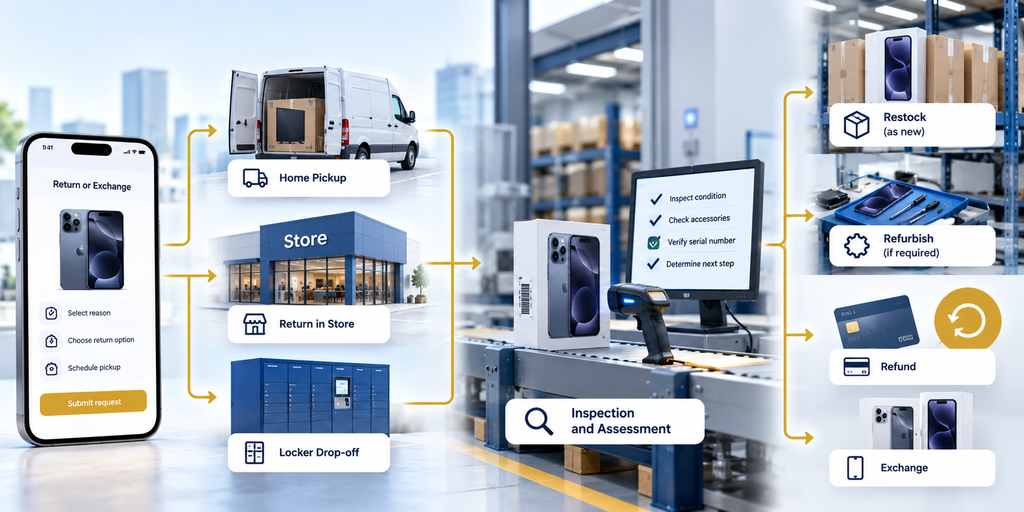
1. Return Request: The customer requests a return online, through Customer Services or in-store. Eligibility is checked against the purchase and returns policy.
2. Return Authorisation: Where applicable, a return reference or Return Merchandise Authorisation (RMA) is created for tracking.
3. Collection or Drop-off: The product is collected, returned to a store or dropped at an approved location.
4. Receiving and Inspection: The retailer checks the item, its condition and the reason for return.
5. Resolution: Depending on the outcome, the product may be restocked, repaired, returned to a supplier or handled through another route, with the appropriate refund or exchange processed.
The Operational Challenge
Reverse logistics is not simply delivery in the opposite direction. Returned products arrive through different channels and in different conditions. An unopened item may be suitable for resale after checks, while a damaged appliance could need specialist handling.
Retailers need accurate visibility of returned products, inventory status and customer refunds. The challenge is to keep the process convenient without losing control of costs or stock accuracy.
Omnichannel Returns: Small Items vs Large Appliances
For retailers operating both physical stores and digital channels, allowing customers to return online purchases in-store can make the experience more convenient. However, the process must be supported by the retailer’s systems, policies and operational capabilities.
Returning Small Items to a Store
Imagine a customer purchases a mobile phone online but decides to return it. Rather than arranging a courier collection, the customer visits a nearby store.
The store colleague retrieves the online order, checks return eligibility and accepts the product according to the retailer’s policy. Depending on the product’s condition, further inspection may be required before a refund is approved.
For the customer, the experience should feel like one straightforward interaction, regardless of where the original purchase was made.
Returning Large Home Appliances
Returning a refrigerator or washing machine presents different challenges. Customers cannot easily transport these products to a store, so the retailer may need to arrange collection from their home.
This requires coordination between Customer Services, Home Delivery and warehouse teams. A suitable vehicle, delivery crew and collection slot may be needed, particularly for large or heavy products.
Once collected, the appliance may require inspection at a designated facility before a decision is made about repair, resale, supplier return or another appropriate outcome.
The objective is to offer customers convenient return options while recognising that different products require different operational processes.
Product Inspection, Inventory Decisions and Exchanges
Once a returned product reaches a store, warehouse or designated returns facility, the retailer must determine its condition and what should happen next.
Product Inspection and Inventory Decisions
Not every returned product can go straight back into available inventory.
For example, an unopened mobile phone may be suitable for resale after the required checks, while a used or faulty product may need technical inspection. A damaged refrigerator could require repair, supplier assessment or disposal, depending on its condition and the retailer’s policies.
The inspection outcome determines whether the product can be restocked, repaired, returned to the supplier or handled through another appropriate process.
Accurate inventory updates are essential. A returned product should not become available for sale until it has been assessed and approved for resale.
Managing Product Exchanges
Exchanges introduce an additional challenge because the retailer must manage both the returned product and the replacement.
Imagine a customer purchases a washing machine but discovers that it does not fit the available space. The customer requests an exchange for a smaller model.
Subject to the retailer’s policy, the process may involve checking replacement availability, calculating any price difference, arranging collection of the original washing machine and scheduling delivery of the replacement.
In some cases, the retailer may coordinate collection and replacement delivery during the same visit, reducing inconvenience for the customer and potentially avoiding additional transport costs.
For partial exchanges, the retailer must ensure that only the relevant product is exchanged without affecting the remaining items in the original order.
A well-managed exchange should make it easy for customers to find a suitable alternative while ensuring the returned product, replacement inventory and financial adjustments are handled correctly.
The Role of Customer Services
While technology and operational teams manage much of the work behind cancellations, returns and exchanges, Customer Services colleagues play an equally important role in shaping the customer experience.
Whether through a call centre, social media, live chat or face-to-face interactions in stores, these colleagues are often the first point of contact when customers need help.
Turning Problems into Positive Experiences
Imagine a customer waiting for a refund that has taken longer than expected. The systems may show that the product has been received and the refund is being processed, but the customer may not understand why the money has not reached their account.
A knowledgeable Customer Services colleague can investigate the situation, coordinate with the relevant teams, explain the next steps and keep the customer informed.
The same applies when a customer visits a store to exchange a faulty product or contacts the retailer to cancel an order that has already been picked.
In these situations, taking ownership, providing accurate information and following through on commitments can make a significant difference to customer satisfaction.
Customer Services and Retention
A cancellation or return does not necessarily mean losing a customer. How the retailer handles the situation can influence whether that customer feels confident purchasing again.
Customer Services colleagues help protect that relationship by resolving problems fairly, managing expectations and treating customers with understanding and professionalism.
Systems enable the process, and operational teams make it happen. Customer Services brings the human element that can turn a difficult experience into an opportunity to build trust and long-term customer loyalty.
Learning from Cancellations, Returns and Customer Complaints
Retailers should not simply process cancellations, returns and exchanges and move on. Understanding why customers cancel or return products can reveal problems that might otherwise go unnoticed.
For example, frequent cancellations may indicate inaccurate stock availability, delivery delays or gaps in the fulfilment process. A high return rate for a particular product could suggest quality issues, misleading product descriptions or differences between customer expectations and the actual product.
Customer Services colleagues play an important role in identifying these problems. Through calls, social media, live chat and store interactions, they hear directly from customers and can highlight recurring complaints that may not be obvious from system reports alone.
Retailers should regularly review cancellation and return reasons, investigate recurring issues and work with the relevant teams to implement corrective actions. Not every cancellation or return indicates a business problem, but identifying and addressing avoidable causes can reduce operational costs, improve customer satisfaction and support long-term retention.
Measuring Cancellations, Returns and Exchanges
Retailers should measure cancellations, returns and exchanges from both an operational and customer perspective. While processing costs and efficiency matter, customer satisfaction is equally important.
The following KPIs can help retailers understand performance and identify opportunities for improvement.
| KPI | What It Measures |
| Order Cancellation Rate | Percentage of orders cancelled, ideally analysed by cancellation reason and fulfilment stage. |
| Product Return Rate | Percentage of products sold that are subsequently returned, analysed by category, product and reason. |
| Return and Exchange Processing Time | Time taken to complete a return or exchange, from request to resolution. |
| Refund Processing Time | Time between refund eligibility being confirmed and the retailer initiating the refund. |
| Customer Satisfaction | How satisfied customers are with their cancellation, return or exchange experience. |
These metrics should not be reviewed in isolation. For example, a retailer may process refunds quickly but still receive poor customer feedback because communication was unclear or the return process was inconvenient.
The objective is not simply to reduce cancellations and returns, but to resolve them efficiently, understand their causes and maintain customer confidence.
Final Thoughts
Cancellations, returns and exchanges are an important part of the ecommerce journey. While they can create operational challenges and additional costs, how retailers handle them can have a lasting impact on customer trust, satisfaction and retention.
Behind every cancellation, return or exchange are systems, processes and people working together. From warehouse and delivery teams to Customer Services colleagues, each plays an important role in making the experience as simple as possible for customers.
Retailers should also learn from these interactions, identify recurring problems and address their root causes wherever possible.
Ultimately, a cancellation or return does not have to mean losing a customer. A simple, fair and well-managed experience can help build the confidence that brings them back.