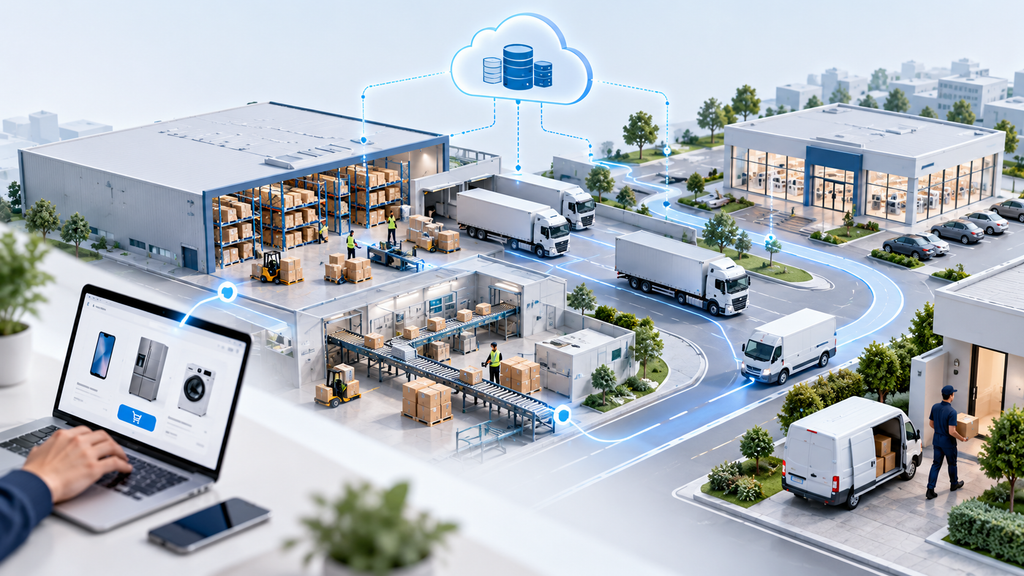
Buying something online takes just a few clicks. But have you ever wondered what really happens between placing an order and receiving it at your doorstep?
Behind that simple experience is a complex operation. Products need to be available, orders processed, goods picked and packed, and deliveries organised. All of this requires people, processes and systems working together.
And while technology plays an important role, the real superheroes are the people behind the scenes. From warehouse colleagues and supply chain teams to delivery drivers, store staff and Customer Services, thousands of everyday activities come together to fulfil a single customer promise.
People make it happen. Systems make it possible at scale. In this article, we will follow an online order from click to customer, exploring how the different parts of ecommerce work together and recognising the people who make it all possible.
Why I Wrote This Series
Ecommerce is often discussed in terms of websites, apps, marketing, conversion rates and sales. But there is much more to running a successful ecommerce business than what customers see on their screens.
I wrote this seven-part series to explain the people, processes and systems working behind the scenes, using simple language and practical retail examples.
It is intended for business leaders, directors, executives and professionals who are new to ecommerce or want to broaden their understanding of how it operates.
The aim is not to explain how these systems are developed or configured. It is to help readers understand what they do, how they connect and why they matter to the business.
One Order, Multiple Fulfilment Decisions
Imagine a customer ordering a mobile phone and a refrigerator from the same ecommerce website.
The mobile phone is available at a nearby store, while the refrigerator is stocked at a distribution centre. Although the customer places a single order, the two products may need to be fulfilled from different locations and delivered separately.
This is where the Order Management System (OMS) comes into play.
Think of the OMS as the brain behind ecommerce fulfilment. It coordinates what happens to an order after it is placed, applying business rules to determine where products should be fulfilled from and how they should reach the customer.
Three Things Worth Understanding
- One order can involve multiple fulfilment locations. Products may come from warehouses, stores or other available stock locations.
- Business rules drive fulfilment decisions. The OMS applies rules defined by the retailer, considering factors such as stock availability, delivery location and operational capacity.
- Technology coordinates the process, but people define how it works. Operational and business teams establish the rules that determine how orders are fulfilled.
With the fulfilment decisions made, the next step is to prepare the products for delivery. But before we explore what happens inside the warehouse, it is worth understanding how the order connects to the wider retail business.
Explore Further: Order Management Systems (OMS): The Brain Behind Ecommerce Fulfilment
ERP: Connecting Ecommerce to the Wider Business
When a customer places an order, the impact goes beyond picking and delivering products. The sale also affects the retailer’s financial records, inventory valuation and wider business operations.
This is where Enterprise Resource Planning (ERP) comes in.
Think of ERP as the system that helps manage the retailer’s core business activities, including finance, purchasing, inventory accounting and supplier transactions.
For example, when the customer purchases a mobile phone and refrigerator, the retailer needs to record the sale, account for the cost of the products and manage the relevant financial transactions. ERP helps maintain these records and supports accurate business reporting.
Three Things Worth Understanding
- ERP connects ecommerce with the wider business. Online sales become part of the retailer’s financial and operational records.
- ERP supports purchasing and supplier management. It helps manage purchase orders, goods receipts and supplier transactions.
- Accurate information matters. Reliable financial and inventory records help retailers understand costs, profitability and overall business performance.
While the customer sees a simple online transaction, ERP helps ensure the business can account for what has been sold, purchased and received.
Explore Further: Enterprise Resource Planning (ERP): The Heart of Retail Operations
Inventory & Supply Chain: Having the Right Products in the Right Places
Before a customer can order a mobile phone or refrigerator, the retailer needs to ensure those products are available.
This involves much more than simply having stock in a warehouse. Products need to be purchased, transported, received and distributed across stores and fulfilment locations based on customer demand.
Inventory and supply chain teams play an important role in making this happen.
For example, a retailer may have plenty of refrigerators in one distribution centre but limited stock in another region where demand is higher. The role of the supply chain team is to identify these gaps and arrange stock transfers or replenishment to ensure products are available where customers need them.
Three Things Worth Understanding
- Stock availability is not just about quantity. Having the right products in the right locations is equally important.
- Demand forecasting supports better decisions. Retailers use historical sales, seasonal patterns and expected demand to plan purchasing and replenishment.
- Inventory must be managed across channels. Stores, warehouses and online fulfilment operations may all depend on the same stock network.
These activities take place long before the customer clicks Buy. Good inventory planning helps retailers avoid missed sales opportunities while reducing excess stock and unnecessary operational costs.
Explore Further: Inventory & Supply Chain Management: Getting the Right Stock to the Right Place
WMS: The People and Processes Behind Warehouse Fulfilment
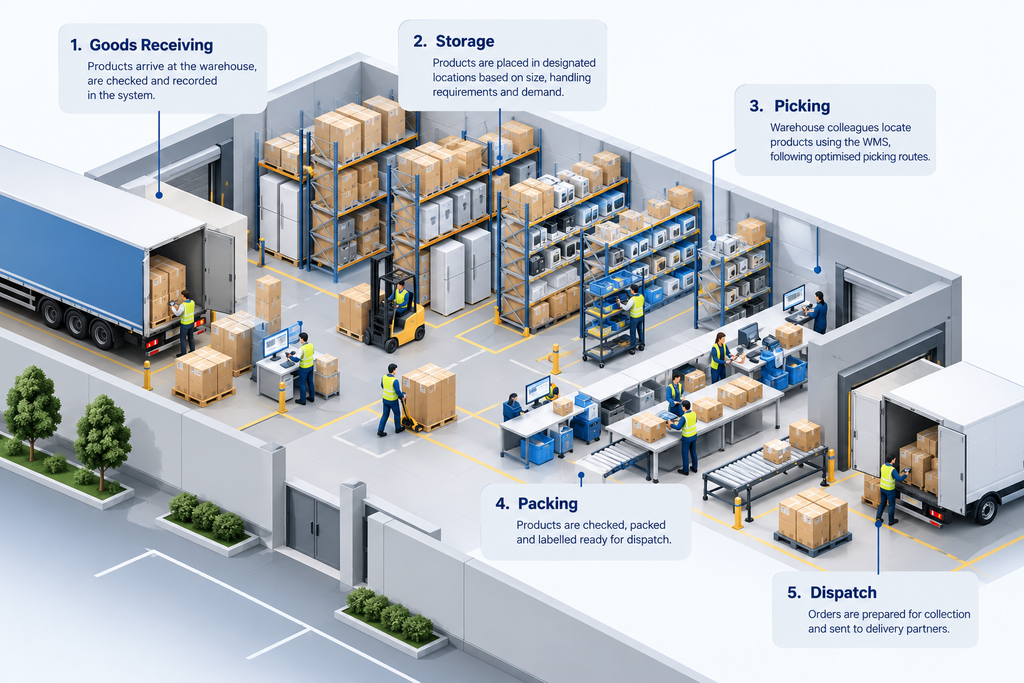
Walk into a busy distribution centre and you will find products arriving, forklifts moving, colleagues replenishing shelves and orders being prepared for dispatch.
Behind these activities is the Warehouse Management System (WMS), which helps organise and manage day-to-day warehouse operations.
When products arrive, warehouse colleagues receive and check them before placing them in designated storage locations. A refrigerator may require a large storage area, while mobile phones can be stored in smaller, secure locations.
When our customer’s order is ready for fulfilment, the WMS helps warehouse colleagues locate the products, manage picking and packing, and prepare shipments for dispatch.
Three Things Worth Understanding
- Warehouse operations begin before an order is placed. Receiving, checking, storing and replenishing products are essential parts of warehouse management.
- Storage locations matter. Products are organised based on factors such as size, handling requirements and demand to support efficient operations.
- The WMS guides warehouse activities. It helps colleagues locate products, complete tasks and maintain accurate stock records.
The WMS provides the instructions and visibility, but it is the warehouse colleagues who carry out the physical work that keeps products moving.
Explore Further: Warehouse Management Systems (WMS): The Engine Behind Ecommerce Fulfilment
Delivery Aggregators: Connecting Orders to Delivery Partners
Our customer’s mobile phone and refrigerator are now ready for dispatch. But how does the retailer decide who will deliver them?
A retailer may work with several delivery companies, each offering different services, geographical coverage, delivery capacity and costs.
This is where a Delivery Aggregator comes into play.
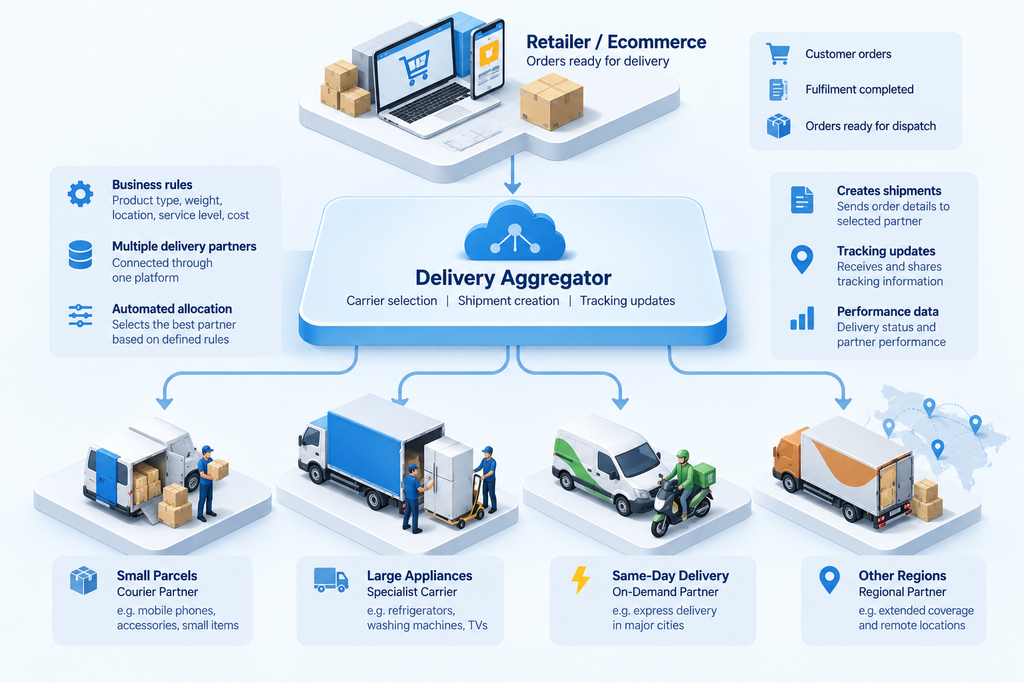
A delivery aggregator connects the retailer’s systems with multiple delivery partners through a single platform. Based on business rules defined by the retailer, it can help select an appropriate delivery partner, create shipments and share tracking information.
For example, the mobile phone may be allocated to a small-parcel courier, while the refrigerator requires a specialist delivery company with suitable vehicles and handling capabilities.
Three Things Worth Understanding
- Different products require different delivery services. Product size, weight, location and service requirements influence carrier selection.
- Business rules guide delivery allocation. Retailers can define rules based on delivery coverage, cost, service levels and carrier capacity.
- One platform can connect multiple delivery partners. This simplifies shipment creation, tracking updates and delivery coordination.
Delivery aggregators help retailers manage multiple delivery relationships without having to integrate separately with every carrier.
But selecting a delivery partner is only part of the journey. The next challenge is ensuring the products actually reach the customer safely and on time.
Explore Further: Delivery Aggregators: Connecting Ecommerce Orders to Delivery Partners
Last-Mile Delivery: The Final Step to the Customer
Our customer’s mobile phone and refrigerator are ready for delivery. But getting them to the doorstep involves more than simply loading them onto a vehicle.
This final stage is known as last-mile delivery.
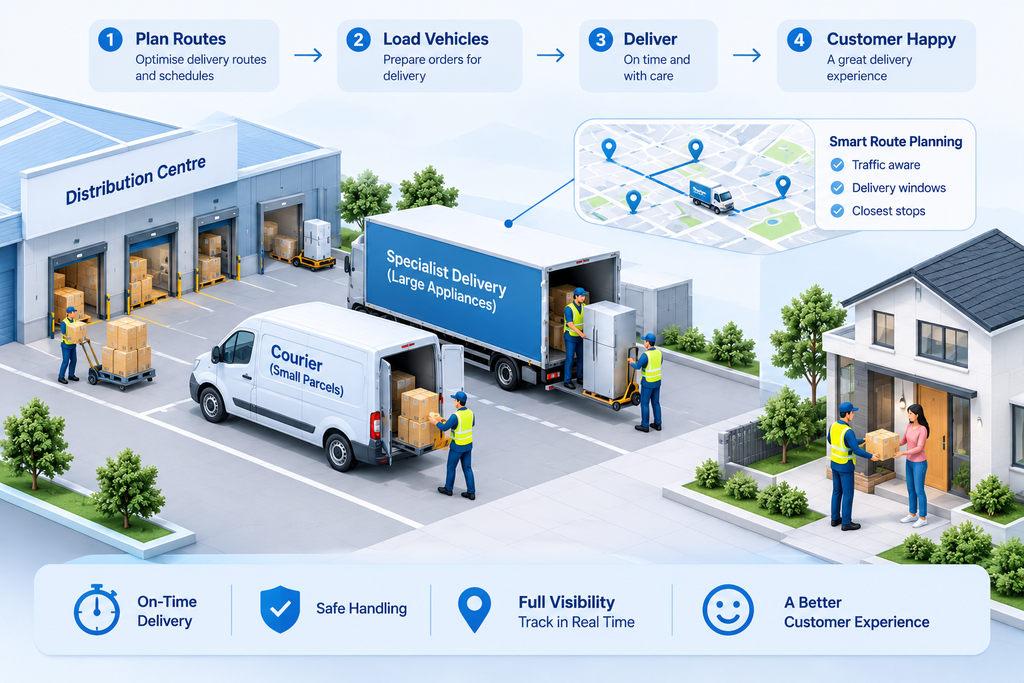
The mobile phone may be delivered by a courier handling dozens of small parcels, while the refrigerator requires a larger vehicle, careful handling and potentially a two-person delivery team.
Behind each delivery is a team planning routes, managing vehicle capacity, organising delivery schedules and ensuring products reach customers safely and on time.
Three Things Worth Understanding
- Delivery planning starts before vehicles leave the warehouse. Routes, delivery slots and available capacity must be coordinated to meet customer commitments.
- Vehicle loading affects delivery efficiency. For large appliances, products are often loaded in reverse delivery order so those needed first are easier to access.
- The shortest route is not always the best route. Traffic conditions, delivery locations, customer availability and delivery windows all influence route planning.
For delivery drivers and their supporting teams, every stop represents a customer waiting for an order. Their work turns the retailer’s delivery promise into the customer’s actual experience.
Explore Further: Last-Mile Delivery: The Final Step in the Ecommerce Journey
Cancellations, Returns and Exchanges: When the Journey Goes in Reverse
Delivering an order is not always the end of the customer journey. Sometimes customers change their minds, receive a damaged product or need to exchange an item.
Imagine our customer decides to cancel the mobile phone but keep the refrigerator. If the phone has not yet been dispatched, the cancellation may be relatively straightforward. If it has already been delivered, the retailer needs to arrange a return, inspect the product and process the refund.
Returning a mobile phone to a store may be simple, while returning a refrigerator could require a collection vehicle, additional handling and coordination with the warehouse.
This process is known as reverse logistics, and it can involve several operational teams and systems working together.
Three Things Worth Understanding
- The stage of the order matters. Cancelling an order before picking is different from cancelling one that has already been dispatched.
- Returns and exchanges require operational coordination. Product collection, inspection, stock updates, replacement fulfilment and refunds must be managed correctly.
- Customer Services plays a critical role. Whether through contact centres, social media or store colleagues, clear communication and timely resolution help maintain customer trust.
A cancellation or return does not necessarily mean losing a customer. How the retailer handles the experience can influence whether that customer chooses to shop again.
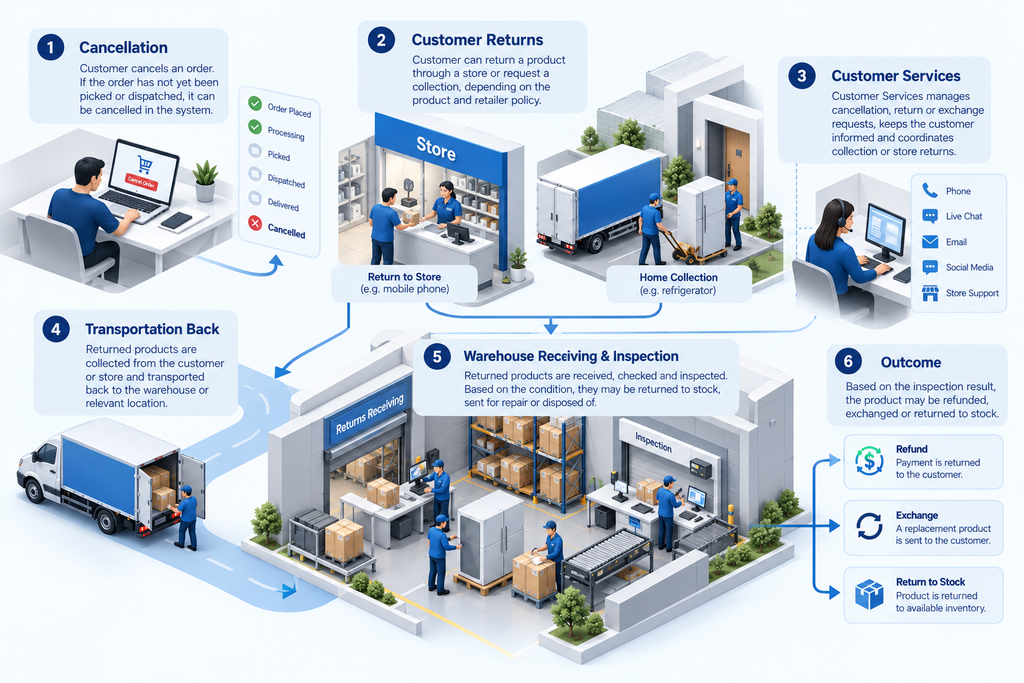
Explore Further: Cancellations, Returns and Exchanges: The Reverse Journey of an Ecommerce Order
Final Thoughts: The Bigger Picture Behind Ecommerce
What looks like a simple online purchase is actually the result of a much larger retail operation.
Throughout this series, I have explained how different systems support ecommerce, from managing orders and inventory to warehouse fulfilment, delivery and returns. But technology is only part of the story.
Behind every successful order are people making decisions, solving problems and keeping operations moving. Their work may not always be visible to customers, but it is essential to delivering a reliable shopping experience.
For business leaders, understanding how these activities connect is important. A decision made in one part of the operation can affect costs, efficiency and customer satisfaction elsewhere. Successful ecommerce is not simply about generating orders. It is about having the people, processes and systems in place to fulfil the promises made to customers.